


Page 22 - IB February 2025
P. 22
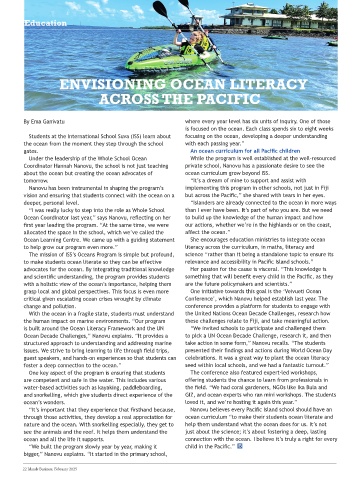
Education                                                                                                                                                                                                  Education


                    ENVISIONING OCEAN LITERACY

                                 ACROSS THE PACIFIC


         By Ema Ganivatu                                     where every year level has six units of inquiry. One of those
                                                             is focused on the ocean. Each class spends six to eight weeks
          Students at the International School Suva (ISS) learn about   focusing on the ocean, developing a deeper understanding
         the ocean from the moment they step through the school   with each passing year.”
         gates.                                                An ocean curriculum for all Pacific children
          Under the leadership of the Whole School Ocean       While the program is well established at the well-resourced
         Coordinator Hannah Nanovu, the school is not just teaching   private school, Nanovu has a passionate desire to see the
         about the ocean but creating the ocean advocates of   ocean curriculum grow beyond ISS.
         tomorrow.                                             “It’s a dream of mine to support and assist with
          Nanovu has been instrumental in shaping the program’s   implementing this program in other schools, not just in Fiji
         vision and ensuring that students connect with the ocean on a   but across the Pacific,” she shared with tears in her eyes.
         deeper, personal level.                               “Islanders are already connected to the ocean in more ways
          “I was really lucky to step into the role as Whole School   than I ever have been. It’s part of who you are. But we need
         Ocean Coordinator last year,” says Nanovu, reflecting on her   to build up the knowledge of the human impact and how
         first year leading the program. “At the same time, we were   our actions, whether we’re in the highlands or on the coast,
         allocated the space in the school, which we’ve called the   affect the ocean.”
         Ocean Learning Centre. We came up with a guiding statement   She encourages education ministries to integrate ocean
         to help grow our program even more.”                literacy across the curriculum, in maths, literacy and
          The mission of ISS’s Oceans Program is simple but profound,   science “rather than it being a standalone topic to ensure its
         to make students ocean literate so they can be effective   relevance and accessibility in Pacific Island schools.”
         advocates for the ocean. By integrating traditional knowledge   Her passion for the cause is visceral. “This knowledge is
         and scientific understanding, the program provides students   something that will benefit every child in the Pacific, as they
         with a holistic view of the ocean’s importance, helping them   are the future policymakers and scientists.”
         grasp local and global perspectives. This focus is even more   One initiative towards this goal is the ‘Veivueti Ocean
         critical given escalating ocean crises wrought by climate   Conference’, which Nanovu helped establish last year. The
         change and pollution.                               conference provides a platform for students to engage with
          With the ocean in a fragile state, students must understand   the United Nations Ocean Decade Challenges, research how
         the human impact on marine environments. “Our program   these challenges relate to Fiji, and take meaningful action.
         is built around the Ocean Literacy Framework and the UN   “We invited schools to participate and challenged them
         Ocean Decade Challenges,” Nanovu explains. “It provides a   to pick a UN Ocean Decade Challenge, research it, and then
         structured approach to understanding and addressing marine   take action in some form,” Nanovu recalls. “The students
         issues. We strive to bring learning to life through field trips,   presented their findings and actions during World Ocean Day
         guest speakers, and hands-on experiences so that students can   celebrations. It was a great way to plant the ocean literacy
         foster a deep connection to the ocean.”             seed within local schools, and we had a fantastic turnout.”
          One key aspect of the program is ensuring that students   The conference also featured expert-led workshops,
         are competent and safe in the water. This includes various   offering students the chance to learn from professionals in
         water-based activities such as kayaking, paddleboarding,   the field. “We had coral gardeners, NGOs like Ika Bula and
         and snorkelling, which give students direct experience of the   GIZ, and ocean experts who ran mini workshops. The students
         ocean’s wonders.                                    loved it, and we’re hosting it again this year.”
          “It’s important that they experience that firsthand because,   Nanovu believes every Pacific Island school should have an
         through those activities, they develop a real appreciation for   ocean curriculum “to make their students ocean literate and
         nature and the ocean. With snorkelling especially, they get to   help them understand what the ocean does for us. It’s not
         see the animals and the reef. It helps them understand the   just about the science; it’s about fostering a deep, lasting
         ocean and all the life it supports.                 connection with the ocean. I believe it’s truly a right for every
          “We built the program slowly year by year, making it   child in the Pacific.”
         bigger,” Nanovu explains. “It started in the primary school,

        22 Islands Business, February 2025

