


Page 19 - IB February 2025
P. 19
Education                                                                                     Education


        depression threatened to develop into a cyclone.
         “We had to stop the setup and take down all the tents to
        avoid damage,” Durpaire recalled.
         Despite these setbacks, the team eventually succeeded in
        erecting 50 tents, ensuring that students had a safe place to
        continue their studies.
         The collaboration was made possible by the pre-positioned
        emergency supplies and financial support from partners such
        as the UK’s Department for International Development (DFID).
         According to Durpaire, the tents were not only a temporary
        measure but also a vital part of the broader strategy to
        restore some sense of normalcy to affected communities.
         “The rapid deployment of these temporary learning spaces
        was a lifeline for many children, ensuring they could continue
        their education and heal from the trauma.”

         Prioritising mental health and emotional well-being
         UNICEF has been working alongside other organisations
        to provide psychosocial support to children, teachers, and
        caregivers.
         “We started training teachers and different stakeholders
        on how to recognise and address mental health issues among
        children,” he explained.
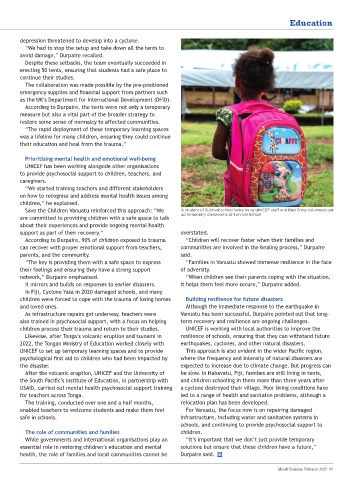
         Save the Children Vanuatu reinforced this approach: “We   A student of Survival school looks on as UNICEF staff and Red Cross volunteers set
        are committed to providing children with a safe space to talk   up temporary classrooms at Survival School
        about their experiences and provide ongoing mental health
        support as part of their recovery.”                 overstated.
         According to Durpaire, 90% of children exposed to trauma   “Children will recover faster when their families and
        can recover with proper emotional support from teachers,   communities are involved in the healing process,” Durpaire
        parents, and the community.                         said.
         “The key is providing them with a safe space to express   “Families in Vanuatu showed immense resilience in the face
        their feelings and ensuring they have a strong support   of adversity.
        network,” Durpaire emphasised.                        “When children see their parents coping with the situation,
         It mirrors and builds on responses to earlier disasters.  it helps them feel more secure,” Durpaire added.
         In Fiji, Cyclone Yasa in 2020 damaged schools, and many
        children were forced to cope with the trauma of losing homes   Building resilience for future disasters
        and loved ones.                                       Although the immediate response to the earthquake in
         As infrastructure repairs got underway, teachers were   Vanuatu has been successful, Durpaire pointed out that long-
        also trained in psychosocial support, with a focus on helping   term recovery and resilience are ongoing challenges.
        children process their trauma and return to their studies.  UNICEF is working with local authorities to improve the
         Likewise, after Tonga’s volcanic eruption and tsunami in   resilience of schools, ensuring that they can withstand future
        2022, the Tongan Ministry of Education worked closely with   earthquakes, cyclones, and other natural disasters.
        UNICEF to set up temporary learning spaces and to provide   This approach is also evident in the wider Pacific region,
        psychological first aid to children who had been impacted by   where the frequency and intensity of natural disasters are
        the disaster.                                       expected to increase due to climate change. But progress can
         After the volcanic eruption, UNICEF and the University of   be slow. In Nabavatu, Fiji, families are still living in tents,
        the South Pacific’s Institute of Education, in partnership with   and children schooling in them more than three years after
        USAID, carried out mental health psychosocial support training   a cyclone destroyed their village. Poor living conditions have
        for teachers across Tonga.                          led to a range of health and sanitaton problems, although a
         The training, conducted over one and a half months,   relocation plan has been developed.
        enabled teachers to welcome students and make them feel   For Vanuatu, the focus now is on repairing damaged
        safe in schools.                                    infrastructure, including water and sanitation systems in
                                                            schools, and continuing to provide psychosocial support to
         The role of communities and families               children.
         While governments and international organisations play an   “It’s important that we don’t just provide temporary
        essential role in restoring children’s education and mental   solutions but ensure that these children have a future,”
        health, the role of families and local communities cannot be   Durpaire said.

                                                                                           Islands Business, February 2025  19

