


Page 31 - IB September 2024
P. 31
Building and Construction                                               Building and Construction


                       PALAU’S ANCIENT BUILDERS


            UNCOVERING MONUMENTAL EARTHWORKS IN PRISTINE PALAU


         A project to understand and map Palau’s ‘green pyramids’,
        monumental earthworks from thousands of years ago, is
        bringing attention to a largely unknown period of early
        construction.
         Over millennia, humans have shaped and altered the
        natural landscape, moving millions of tonnes of earth and
        building terraced hillsides (ouballang), steep and high crowns,
        deep moats and trenches and large platforms.
         It is a very early example of adaptation, with the earliest
        examples dating back to around 500BC.
         Researchers say like Rapa Nui’s giant stone statues and
        Pohnpei’s Nan Madol, they are man-made displays of power
        through large, highly visible construction.
         The research project is a collaboration between Christian-
        Albrechts University in Germany and the Palau Resource
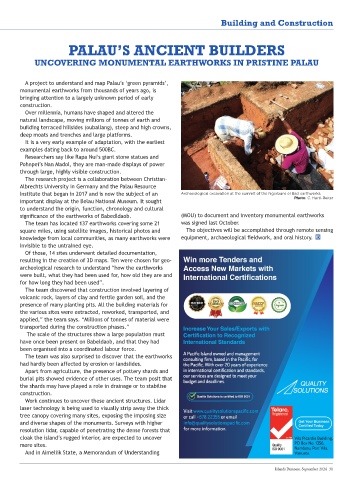
        Institute that began in 2017 and is now the subject of an   Archaeological excavation at the summit of the Ngerbuns el Bad earthworks.
        important display at the Belau National Museum. It sought                                Photo: C. Hartl-Reiter
        to understand the origin, function, chronology and cultural
        significance of the earthworks of Babedldaob.       (MOU) to document and inventory monumental earthworks
         The team has located 137 earthworks covering some 21   was signed last October.
        square miles, using satellite images, historical photos and   The objectives will be accomplished through remote sensing
        knowledge from local communities, as many earthworks were   equipment, archaeological fieldwork, and oral history.
        invisible to the untrained eye.
         Of those, 14 sites underwent detailed documentation,
        resulting in the creation of 3D maps. Ten were chosen for geo-
        archeological research to understand “how the earthworks
        were built, what they had been used for, how old they are and
        for how long they had been used”.
         The team discovered that construction involved layering of
        volcanic rock, layers of clay and fertile garden soil, and the
        presence of many planting pits. All the building materials for
        the various sites were extracted, reworked, transported, and
        applied,” the team says. “Millions of tonnes of material were
        transported during the construction phases.”
          The scale of the structures show a large population must
        have once been present on Babeldaob, and that they had
        been organised into a coordinated labour force.
         The team was also surprised to discover that the earthworks
        had hardly been affected by erosion or landslides.
         Apart from agriculture, the presence of pottery shards and
        burial pits showed evidence of other uses. The team posit that
        the shards may have played a role in drainage or to stabilise
        construction.
         Work continues to uncover these ancient structures. Lidar
        laser technology is being used to visually strip away the thick
        tree canopy covering many sites, exposing the imposing size
        and diverse shapes of the monuments. Surveys with higher
        resolution lidar, capable of penetrating the dense forests that
        cloak the island’s rugged interior, are expected to uncover
        more sites.
         And in Aimeliik State, a Memorandum of Understanding


                                                                                           Islands Business, September 2024  31

