


Page 24 - IB September 2024
P. 24
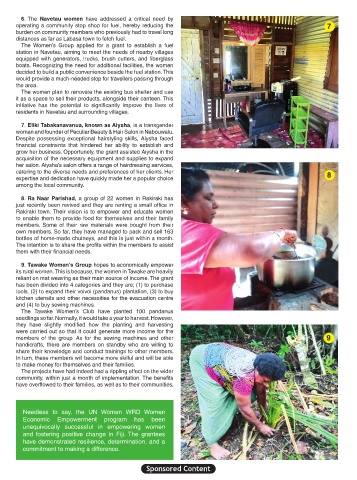
6. The  Navetau women have addressed a critical need by
      operating a community stop shop for fuel, hereby reducing the
      burden on community members who previously had to travel long
      distances as far as Labasa town to fetch fuel.
        The  Women’s Group applied for a grant to establish a fuel
      station in Navetau, aiming to meet the needs of nearby villages
      equipped with generators, trucks, brush cutters, and fiberglass
      boats. Recognizing the need for additional facilities, the women
      decided to build a public convenience beside the fuel station. This
      would provide a much-needed stop for travellers passing through
      the area.
        The women plan to renovate the existing bus shelter and use
      it as a space to sell their products, alongside their canteen. This
      initiative has the potential to significantly improve the lives of
      residents in Navetau and surrounding villages.

        7. Eliki Tabakanavanua, known as Aiysha, is a transgender
      woman and founder of Peculiar Beauty & Hair Salon in Nabouwalu.
      Despite possessing exceptional hairstyling skills, Aiysha faced
      financial constraints that hindered her ability to establish and
      grow her business. Opportunely, the grant assisted Aiysha in the
      acquisition of the necessary equipment and supplies to expand
      her salon. Aiysha’s salon offers a range of hairdressing services,
      catering to the diverse needs and preferences of her clients. Her
      expertise and dedication have quickly made her a popular choice
      among the local community.

        8. Ra Naar Parishad, a group of 22 women in Rakiraki has
      just recently been revived and they are renting a small office in
      Rakiraki town. Their vision is to empower and educate women
      to enable them to provide food for themselves and their family
      members. Some of their raw materials were bought from their
      own members. So far, they have managed to pack and sell 163
      bottles of home-made chutneys, and this is just within a month.
      The intention is to share the profits within the members to assist
      them with their financial needs.

        9. Tawake Women’s Group hopes to economically empower
      its rural women. This is because, the women in Tawake are heavily
      reliant on mat weaving as their main source of income. The grant
      has been divided into 4 categories and they are; (1) to purchase
      tools, (2) to expand their voivoi (pandanus) plantation, (3) to buy
      kitchen utensils and other necessities for the evacuation centre
      and (4) to buy sewing machines.
        The  Tawake  Women’s Club have planted 100 pandanus
      seedlings so far. Normally, it would take a year to harvest. However,
      they have slightly modified how the planting and harvesting
      were carried out so that it could generate more income for the
      members of the group. As for the sewing machines and other
      handicrafts, there are members on standby who are willing to
      share their knowledge and conduct trainings to other members.
      In turn, these members will become more skilful and will be able
      to make money for themselves and their families.
        The projects have had indeed had a rippling effect on the wider
      community, within just a month of implementation. The benefits
      have overflowed to their families, as well as to their communities.


        Needless  to  say, the  UN  Women  WRD  Women
        Economic Empowerment program has been
        unequivocally successful in empowering women
        and fostering positive change in Fiji. The grantees
        have demonstrated resilience, determination, and a
        commitment to making a difference.


        24 Islands Business, September 2024      Sponsored Content

