


Page 25 - IB September 2024
P. 25
Building and Construction


                        BUILDING FOR TOMORROW

                     TURNING TO TRADITION FOR CLIMATE SOLUTIONS


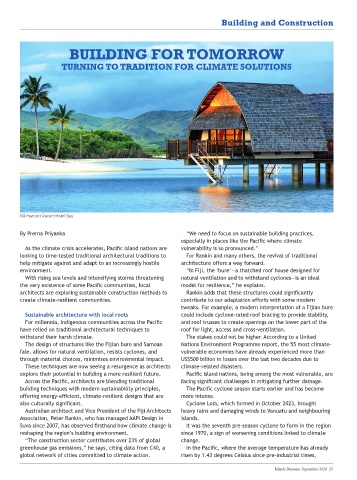
        Fiji Marriott Resort Momi Bay


        By Prerna Priyanka                                    “We need to focus on sustainable building practices,
                                                            especially in places like the Pacific where climate
         As the climate crisis accelerates, Pacific Island nations are   vulnerability is so pronounced.”
        looking to time-tested traditional architectural traditions to   For Rankin and many others, the revival of traditional
        help mitigate against and adapt to an increasingly hostile   architecture offers a way forward.
        environment.                                          “In Fiji, the ‘bure’—a thatched roof house designed for
         With rising sea levels and intensifying storms threatening   natural ventilation and to withstand cyclones—is an ideal
        the very existence of some Pacific communities, local   model for resilience,” he explains.
        architects are exploring sustainable construction methods to   Rankin adds that these structures could significantly
        create climate-resilient communities.               contribute to our adaptation efforts with some modern
                                                            tweaks. For example, a modern interpretation of a Fijian bure
         Sustainable architecture with local roots          could include cyclone-rated roof bracing to provide stability,
         For millennia, Indigenous communities across the Pacific   and roof trusses to create openings on the lower part of the
        have relied on traditional architectural techniques to   roof for light, access and cross-ventilation.
        withstand their harsh climate.                        The stakes could not be higher. According to a United
         The design of structures like the Fijian bure and Samoan   Nations Environment Programme report, the 55 most climate-
        fale, allows for natural ventilation, resists cyclones, and   vulnerable economies have already experienced more than
        through material choices, minimises environmental impact.  US$500 billion in losses over the last two decades due to
         These techniques are now seeing a resurgence as architects   climate-related disasters.
        explore their potential in building a more resilient future.  Pacific Island nations, being among the most vulnerable, are
         Across the Pacific, architects are blending traditional   facing significant challenges in mitigating further damage.
        building techniques with modern sustainability principles,   The Pacific cyclone season starts earlier and has become
        offering energy-efficient, climate-resilient designs that are   more intense.
        also culturally significant.                          Cyclone Lola, which formed in October 2023, brought
         Australian architect and Vice President of the Fiji Architects   heavy rains and damaging winds to Vanuatu and neighbouring
        Association, Peter Rankin, who has managed AAPi Design in   islands.
        Suva since 2007, has observed firsthand how climate change is   It was the seventh pre-season cyclone to form in the region
        reshaping the region’s building environment.        since 1970, a sign of worsening conditions linked to climate
         “The construction sector contributes over 23% of global   change.
        greenhouse gas emissions,” he says, citing data from C40, a   In the Pacific, where the average temperature has already
        global network of cities committed to climate action.  risen by 1.43 degrees Celsius since pre-industrial times,

                                                                                           Islands Business, September 2024  25

