


Page 19 - IB September 2024
P. 19
Cover


                          WHERE ARE THE WOMEN?


        By Sera Tikotikovatu-Sefeti

         The Pacific has seen 15 Triennial Conferences of Pacific
        Women, eight Pacific Ministers for Women meetings, and 30
        years of the Pacific Platform for Action on Gender Equality
        and Women’s Human Rights, but as the 53rd Pacific Islands
        Forum Leaders Meeting (PIFLM) wrapped up in Tonga in
        August, questions were being asked about how much of the
        outcomes from these meetings were brought to the Forum
        Leaders table for discussion this year.
         An observer at a closed plenary session for the 53rd PIFLM,
        Head of the Pacific for Greenpeace Australia Pacific, Shiva
        Gounden, shared his insights: “Gender was not discussed
        much at all; the Republic of the Marshall Islands President,
        Hilde Heine, was the only leader who spoke very strongly
        about the inclusion of gender in terms of any of the Pacific
        issues that have been addressed or will be addressed at this
        Pacific Islands Forum, especially climate change. Aside from
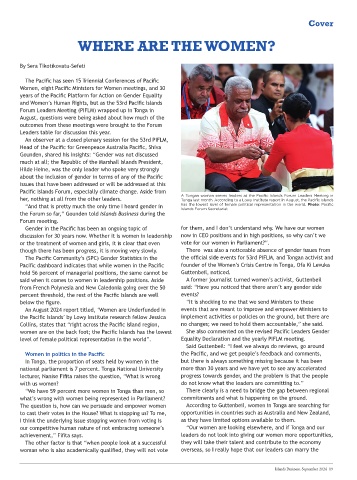
        her, nothing at all from the other leaders.         A Tongan woman serves leaders at the Pacific Islands Forum Leaders Meeting in
                                                            Tonga last month. According to a Lowy Institute report in August, the Pacific Islands
         “And that is pretty much the only time I heard gender in   has the lowest level of female political representation in the world. Photo: Pacific
                                                            Islands Forum Secretariat
        the Forum so far,” Gounden told Islands Business during the
        Forum meeting.
         Gender in the Pacific has been an ongoing topic of   for them, and I don’t understand why. We have our women
        discussion for 30 years now. Whether it is women in leadership   now in CEO positions and in high positions, so why can’t we
        or the treatment of women and girls, it is clear that even   vote for our women in Parliament?”.
        though there has been progress, it is moving very slowly.   There  was also a noticeable absence of gender issues from
         The Pacific Community’s (SPC) Gender Statistics in the   the official side events for 53rd PIFLM, and Tongan activist and
        Pacific dashboard indicates that while women in the Pacific   founder of the Women’s Crisis Centre in Tonga, Ofa Ki Levuka
        hold 56 percent of managerial positions, the same cannot be   Guttenbeil, noticed.
        said when it comes to women in leadership positions. Aside   A former journalist turned women’s activist, Guttenbeil
        from French Polynesia and New Caledonia going over the 50   said: “Have you noticed that there aren’t any gender side
        percent threshold, the rest of the Pacific Islands are well   events?
        below the figure.                                     “It is shocking to me that we send Ministers to these
         An August 2024 report titled, ‘Women are Underfunded in   events that are meant to improve and empower Ministers to
        the Pacific Islands’ by Lowy Institute research fellow Jessica   implement activities or policies on the ground, but there are
        Collins, states that “right across the Pacific Island region,   no changes; we need to hold them accountable,” she said.
        women are on the back foot; the Pacific Islands has the lowest   She also commented on the revised Pacific Leaders Gender
        level of female political representation in the world”.  Equality Declaration and the yearly PIFLM meeting.
                                                              Said Guttenbeil: “I feel we always do reviews, go around
         Women in politics in the Pacific                   the Pacific, and we get people’s feedback and comments,
         In Tonga, the proportion of seats held by women in the   but there is always something missing because it has been
        national parliament is 7 percent. Tonga National University   more than 30 years and we have yet to see any accelerated
        lecturer, Nanise Fifita raises the question, “What is wrong   progress towards gender, and the problem is that the people
        with us women?                                      do not know what the leaders are committing to.”
         “We have 59 percent more women in Tonga than men, so   There clearly is a need to bridge the gap between regional
        what’s wrong with women being represented in Parliament?   commitments and what is happening on the ground.
        The question is, how can we persuade and empower women   According to Guttenbeil, women in Tonga are searching for
        to cast their votes in the House? What is stopping us? To me,   opportunities in countries such as Australia and New Zealand,
        I think the underlying issue stopping women from voting is   as they have limited options available to them.
        our competitive human nature of not embracing someone’s   “Our women are looking elsewhere, and if Tonga and our
        achievement,” Fifita says.                          leaders do not look into giving our women more opportunities,
         The other factor is that “when people look at a successful   they will take their talent and contribute to the economy
        woman who is also academically qualified, they will not vote   overseas, so I really hope that our leaders can marry the


                                                                                           Islands Business, September 2024  19

