


Page 21 - IB August 2024
P. 21
Cover                                                                                              Cover


                        was led by SPREP; traditional knowledge   resources and traditional knowledge.
                        and expressions of culture was led by   “The treaty enables indigenous peoples to demand
                        SPC; and intellectual property rights   international recognition of their indigenous/traditional
                        (patents, inventions, and copyrights/  knowledge systems by providing a benchmark which we can
                        creations) by PIFS.                 now use as the bare minimum standard of ethical practice and
                          This regional effort also resulted in   engagement with indigenous peoples,” adds Vaka’uta.
                        the development of national legislation   “This includes the baseline principles and processes of
                        by Vanuatu, Cook Islands, and Samoa.   engagement. In the past, while several countries have had
                        Vaka’uta said Fiji is currently working on   in place their own national legislature for the protection
       Third  World  Network
       legal advisor, Chetali Rao.   its legislation while other countries such   of traditional knowledge, jurisdiction has been one area of
       Photo: Supplied
                        as Kiribati are beginning legislative work.   concern. An international treaty addresses this issue. This
        In addition, SPREP has produced the Pacific Access and Benefit   is the first WIPO treaty to include provisions specifically for
        Sharing (ABS) Implementation Guidelines for countries.  indigenous peoples, as well as local communities.”
         Vaka’uta said there is a long list of instances where the   Vaka’uta said it needs to be remembered that IP systems
        use of traditional knowledge in the Pacific has not been   were not designed to cater for collective ownership
        sanctioned by the local community of knowledge holders and   arrangements such as those within which indigenous/
        access points have been vague and/or contested. This ranges   traditional knowledge systems operate and exist. This makes
        from the use of traditional knowledge for pharmaceuticals, to   for a tremendous mismatch between Western knowledge
        cosmetics, music, fashion, and even language (names).  systems and traditional knowledge systems, who those in the
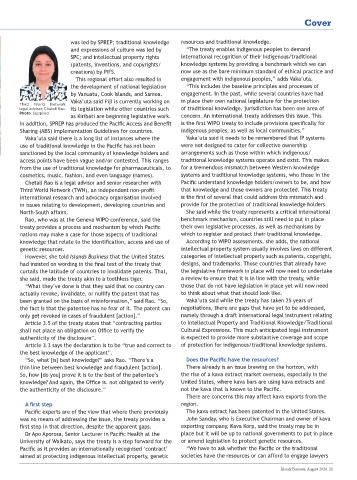
         Chetali Rao is a legal advisor and senior researcher with   Pacific understand knowledge holders/owners to be, and how
        Third World Network (TWN), an independent non-profit   that knowledge and those owners are protected. This treaty
        international research and advocacy organisation involved   is the first of several that could address this mismatch and
        in issues relating to development, developing countries and   provide for the protection of traditional knowledge holders.
        North-South affairs.                                  She said while the treaty represents a critical international
         Rao, who was at the Geneva WIPO conference, said the   benchmark mechanism, countries still need to put in place
        treaty provides a process and mechanism by which Pacific   their own legislative processes, as well as mechanisms by
        nations may make a case for those aspects of traditional   which to register and protect their traditional knowledge.
        knowledge that relate to the identification, access and use of   According to WIPO assessments, she adds, the national
        genetic resources.                                  intellectual property system usually involves laws on different
         However, she told Islands Business that the United States   categories of intellectual property such as patents, copyright,
        had insisted on wording in the final text of the treaty that   designs, and trademarks. Those countries that already have
        curtails the latitude of countries to invalidate patents. That,   the legislative framework in place will now need to undertake
        she said, made the treaty akin to a toothless tiger.   a review to ensure that it is in line with the treaty, while
         “What they’ve done is that they said that no country can   those that do not have legislation in place yet will now need
        actually revoke, invalidate, or nullify the patent that has   to think about what that should look like.
        been granted on the basis of misinformation,” said Rao. “So,   Vaka’uta said while the treaty has taken 25 years of
        the fact is that the patentee has no fear of it. The patent can   negotiations, there are gaps that have yet to be addressed,
        only get revoked in cases of fraudulent [action].”  namely through a draft international legal instrument relating
         Article 3.5 of the treaty states that “contracting parties   to Intellectual Property and Traditional Knowledge/Traditional
        shall not place an obligation on Office to verify the   Cultural Expressions. This much anticipated legal instrument
        authenticity of the disclosure”.                    is expected to provide more substantive coverage and scope
         Article 3.3 says the declaration is to be “true and correct to   of protection for indigenous/traditional knowledge systems.
        the best knowledge of the applicant”.
         “So, what [is] best knowledge?” asks Rao. “There’s a   Does the Pacific have the resources?
        thin line between best knowledge and fraudulent [action].   There already is an issue brewing on the horizon, with
        So, how [do you] prove it is to the best of the patentee’s   the rise of a kava extract market overseas, especially in the
        knowledge? And again, the Office is. not obligated to verify   United States, where kava bars are using kava extracts and
        the authenticity of the disclosure.”                not the kava that is known to the Pacific.
                                                              There are concerns this may affect kava exports from the
         A first step                                       region.
         Pacific experts are of the view that where there previously   The kava extract has been patented in the United States.
        was no means of addressing the issue, the treaty provides a   John Sanday, who is Executive Chairman and owner of kava
        first step in that direction, despite the apparent gaps.  exporting company, Kava Korp, said the treaty may be in
         Dr Apo Aporosa, Senior Lecturer in Pacific Health at the   place but it will be up to national governments to put in place
        University of Waikato, says the treaty is a step forward for the   or amend legislation to protect genetic resources.
        Pacific as it provides an internationally recognised ‘contract’   “We have to ask whether the Pacific or the traditional
        aimed at protecting indigenous intellectual property, genetic   societies have the resources or can afford to engage lawyers

                                                                                            Islands Business, August 2024  21

