


Page 20 - IB August 2024
P. 20
Cover                                                                                                                                                                                                          Cover


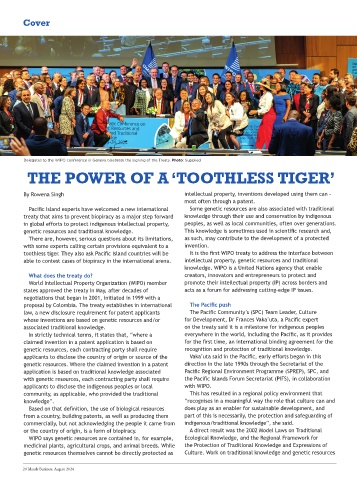
         Delegates to the WIPO conference in Geneva celebrate the signing of the Treaty. Photo: Supplied
          THE POWER OF A ‘TOOTHLESS TIGER’


         By Rowena Singh                                     intellectual property, inventions developed using them can -
                                                             most often through a patent.
          Pacific Island experts have welcomed a new international   Some genetic resources are also associated with traditional
         treaty that aims to prevent biopiracy as a major step forward   knowledge through their use and conservation by indigenous
         in global efforts to protect indigenous intellectual property,   peoples, as well as local communities, often over generations.
         genetic resources and traditional knowledge.        This knowledge is sometimes used in scientific research and,
          There are, however, serious questions about its limitations,   as such, may contribute to the development of a protected
         with some experts calling certain provisions equivalent to a   invention.
         toothless tiger. They also ask Pacific Island countries will be   It is the first WIPO treaty to address the interface between
         able to contest cases of biopiracy in the international arena.  intellectual property, genetic resources and traditional
                                                             knowledge. WIPO is a United Nations agency that enable
          What does the treaty do?                           creators, innovators and entrepreneurs to protect and
          World Intellectual Property Organization (WIPO) member   promote their intellectual property (IP) across borders and
         states approved the treaty in May, after decades of   acts as a forum for addressing cutting-edge IP issues.
         negotiations that began in 2001, initiated in 1999 with a
         proposal by Colombia. The treaty establishes in international   The Pacific push
         law, a new disclosure requirement for patent applicants   The Pacific Community’s (SPC) Team Leader, Culture
         whose inventions are based on genetic resources and/or   for Development, Dr Frances Vaka’uta, a Pacific expert
         associated traditional knowledge.                   on the treaty said it is a milestone for indigenous peoples
          In strictly technical terms, it states that, “where a   everywhere in the world, including the Pacific, as it provides
         claimed invention in a patent application is based on   for the first time, an international binding agreement for the
         genetic resources, each contracting party shall require   recognition and protection of traditional knowledge.
         applicants to disclose the country of origin or source of the   Vaka’uta said in the Pacific, early efforts began in this
         genetic resources. Where the claimed invention in a patent   direction in the late 1990s through the Secretariat of the
         application is based on traditional knowledge associated   Pacific Regional Environment Programme (SPREP), SPC, and
         with genetic resources, each contracting party shall require   the Pacific Islands Forum Secretariat (PIFS), in collaboration
         applicants to disclose the indigenous peoples or local   with WIPO.
         community, as applicable, who provided the traditional   This has resulted in a regional policy environment that
         knowledge”.                                         “recognises in a meaningful way the role that culture can and
          Based on that definition, the use of biological resources   does play as an enabler for sustainable development, and
         from a country, building patents, as well as producing them   part of this is necessarily, the protection and safeguarding of
         commercially, but not acknowledging the people it came from   indigenous/traditional knowledge”, she said.
         or the country of origin, is a form of biopiracy.     A direct result was the 2002 Model Laws on Traditional
          WIPO says genetic resources are contained in, for example,   Ecological Knowledge, and the Regional Framework for
         medicinal plants, agricultural crops, and animal breeds. While   the Protection of Traditional Knowledge and Expressions of
         genetic resources themselves cannot be directly protected as   Culture. Work on traditional knowledge and genetic resources


        20 Islands Business, August 2024

