


Page 22 - IB November 2023
P. 22
Nuclear Issues


         Guinea asked that their continuing interest in the duration of
         ship visits be recorded. PNG also suggested that ship visits be
         made subject to a requirement for prior warning.” However,
         Australia, as Chair of the negotiations, rejected the
         PNG/Vanuatu proposal.

          Nuclear capable aircraft
          Decades on, this historic debate is all the more important,
         as Australia plans to host more US and UK nuclear-capable
         submarines and planes in its territory under the AUKUS
         partnership.
          Gearing up for conflict with China, the US also regularly
         deploys B-52H Stratofortress bombers to Andersen Air Force
         Base in Guam and Tindal Air Base in Australia’s Northern
         Territory. Tindal is jointly operated by the Royal Australian
         Air Force and US Air Force (USAF), and Washington is planning
         further expansion at the base to allow for a B-52H bomber
         task force on permanent rotation.
          Of the 87 B-52H bombers currently operated by the USAF,
         46 are nuclear-capable, with the ability to carry up to 20
         nuclear-armed cruise missiles. Given the US maintains a
         “neither confirm nor deny” policy on nuclear weapons, can
         Australia guarantee that nuclear-tipped missiles won’t be
         stationed on planes at Tindal for lengthy periods, in breach of
         SPNFZ?
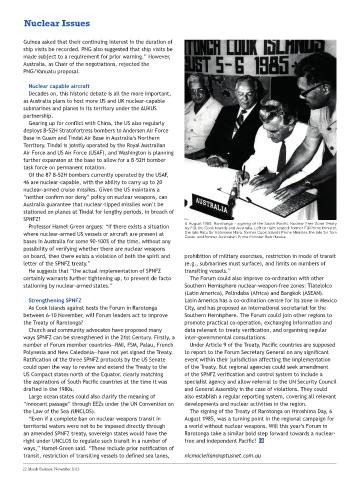
          Professor Hamel-Green argues: “If there exists a situation   6 August 1985, Rarotonga – signing of the South Pacific Nuclear Free Zone Treaty
                                                             by Fiji, the Cook Islands and Australia. Left to right seated: former Fiji Prime Minister,
         where nuclear-armed US vessels or aircraft are present at   the late Ratu Sir Kamisese Mara, former Cook Islands Prime Minister, the late Sir Tom
                                                             Davis, and former Australian Prime Minister Bob Hawke.
         bases in Australia for some 90-100% of the time, without any
         possibility of verifying whether there are nuclear weapons
         on board, then there exists a violation of both the spirit and   prohibition of military exercises, restriction in mode of transit
         letter of the SPNFZ treaty.”                        (e.g., submarines must surface), and limits on numbers of
          He suggests that “the actual implementation of SPNFZ   transiting vessels.”
         certainly warrants further tightening up, to prevent de facto   The Forum could also improve co-ordination with other
         stationing by nuclear-armed states.”                Southern Hemisphere nuclear-weapon-free zones: Tlatelolco
                                                             (Latin America), Pelindaba (Africa) and Bangkok (ASEAN).
          Strengthening SPNFZ                                Latin America has a co-ordination centre for its zone in Mexico
          As Cook Islands against hosts the Forum in Rarotonga   City, and has proposed an international secretariat for the
         between 6-10 November, will Forum leaders act to improve   Southern Hemisphere. The Forum could join other regions to
         the Treaty of Rarotonga?                            promote practical co-operation, exchanging information and
          Church and community advocates have proposed many   data relevant to treaty verification, and organising regular
         ways SPNFZ can be strengthened in the 21st Century. Firstly, a   inter-governmental consultations.
         number of Forum member countries—RMI, FSM, Palau, French   Under Article 9 of the Treaty, Pacific countries are supposed
         Polynesia and New Caledonia—have not yet signed the Treaty.   to report to the Forum Secretary General on any significant
         Ratification of the three SPNFZ protocols by the US Senate   event within their jurisdiction affecting the implementation
         could open the way to review and extend the Treaty to the   of the Treaty. But regional agencies could seek amendment
         US Compact states north of the Equator, clearly matching   of the SPNFZ verification and control system to include a
         the aspirations of South Pacific countries at the time it was   specialist agency and allow referral to the UN Security Council
         drafted in the 1980s.                               and General Assembly in the case of violations. They could
          Large ocean states could also clarify the meaning of   also establish a regular reporting system, covering all relevant
         “innocent passage” through EEZs under the UN Convention on   developments and nuclear activities in the region.
         the Law of the Sea (UNCLOS).                          The signing of the Treaty of Rarotonga on Hiroshima Day, 6
          “Even if a complete ban on nuclear weapons transit in   August 1985, was a turning point in the regional campaign for
         territorial waters were not to be imposed directly through   a world without nuclear weapons. Will this year’s Forum in
         an amended SPNFZ treaty, sovereign states would have the   Rarotonga take a similar bold step forward towards a nuclear-
         right under UNCLOS to regulate such transit in a number of   free and independent Pacific?
         ways,” Hamel-Green said. “These include prior notification of
         transit, restriction of transiting vessels to defined sea lanes,   nicmaclellan@optusnet.com.au

        22 Islands Business, November 2023

