


Page 19 - IB November 2023
P. 19
What the Boy Child Brings Us - El Niño and   indicated  that  4  -  8  severe  tropical  cyclones,
           During  the  PICOF-13,  the  RCC-N  partners

 Implications for the Pacific this Season  reaching  category  3  or  higher  might  occur
         anywhere across the region.
           Whilst the characteristics of El Niño events vary
 Pacific Island Countries are known to host some of  New Zealand Aid funded Climate and Ocean Support   between  countries  in  the  Pacific,  one  thing  for
 the most memorable soirees during the festive season,  Program in the Pacific (COSPPac).  certain is that the impacts on all sectors, including
 but  are  also  the  most  vulnerable  to  extreme  climatic   Ironically, as the Pacific discussed the implications of   agriculture,  fisheries,  health,  tourism  and
 events during the same.  the impacts of El Niño, Tropical Cyclone Lola rapidly   infrastructure  among  others,  last  beyond
 El Niño (pronounced ‘el neen-yo’), literally means ‘the  developed  into  a  severe  Category  5  system  over   the event and have cascading effects with
 boy child’ in Spanish and was used by South American  Vanuatu, reminding us that out-of-season and intense   adverse economic implications.
 fishermen in the 17th century, because it is linked to  cyclones are one of the traits of the phenomenon.   With  the  El  Niño  event  we  are
 the El Niño Southern Oscillation (ENSO) phenomenon,   In  the  PICOF-13  Statement,  all  Pacific  National   currently   experiencing,
 which has the greatest impact on countries around the  Meteorological  Services  reiterated  that  El  Niño  is   agriculture,  fisheries  and
 Equator.  expected  to  continue  through  at  least  March  2024,   water  management  are  the
 El Niño events occur when there is a decrease in the  peaking in December 2023 or January 2024, and will   main  sectors  that  will  be
 strength and intensity of trade winds, which alters the  likely be a strong event.    affected.  Impacts  include  the
 position  of  the  warm  pool  in  the  Western  Equatorial   Overall  implications  for  the  Pacific  region  indicate   effect  of  marine  heatwaves
 Pacific, causing warmer than average ocean water to  that  there  will  be  drier  than  normal  conditions  for   on  fisheries  and  the  impact  of  extreme
 migrate into the Central and Eastern Pacific, typically  much  of  the  off-equatorial  North  and  South  Pacific,   temperatures and humidity on crops. The SST
 resulting  in  above  normal  rainfall.  The  countries  in  between  southern  Papua  New  Guinea  and  Southern   convergence  zone  that  forms  the  boundary
 the  Western  and  off-Equatorial  South  Pacific,  such  French  Polynesia,  and  between  Palau  and  the   of  the  Western  Pacific  warm  pool  is  an
 as Vanuatu, Fiji and Tonga, tend to experience below  northern Marshall Islands. Above normal rainfall will be   important  feature  for  tuna  fisheries,  with  a
 normal  rainfall  which  sometimes  leads  to  prolonged  experienced by countries along the equator, extending   high  correlation  to  skipjack  abundance,
 drought events.  from Eastern Papua New Guinea to the Line Islands of   which  could  result  in  a  higher  than  usual
 Historically, El Nino events tend to be associated with  Kiribati, including Nauru, Tokelau, and Tuvalu.  tuna population around Kiribati.
 hot days, cold nights, drought and flooding – the impacts   Warmer  than  average  sea  surface  temperatures   El  Niño  cannot  be  avoided,  but  its
 vary depending on which country you are in. The last  (SSTs) will be experienced in most of the region, except   adverse impacts can be reduced. All Pacific
 significant El Niño event declared in the Pacific was in  in New Caledonia, Vanuatu, Fiji, and Niue, where near   Islanders  are  encouraged  to  be  vigilant
 mid-2015 through early 2016. El Niño-like conditions in  average  conditions  are  likely.  Slightly  higher  than   and prepare, not just for tropical cyclones,
 late 2019 and early 2020 caused some countries in the  normal  sea  levels  are  predicted  along  the  equator,   but  for  flooding,  coastal  inundation  and
 Pacific to experience drought-like conditions.   which may lead to a risk of coastal inundation around   low  rainfall  leading  to  drought.  For
 In  October,  the  Pacific  Regional  Climate  Centre-  Kiribati, especially during the highest tides.  more  detailed  information  regarding
 Network convened the thirteenth Pacific Islands Climate   In contrast, lower than normal sea levels are forecast   your  country,  contact  the  National
 Outlook Forum (PICOF-13) in Nadi, Fiji. PICOF-13 was  for  the  western  part  of  the  region,  near  Palau,  the   Meteorological   and   Hydrological
 well attended by over 105 participants, from 17 Pacific  Federated  States  of  Micronesia,  Marshall  Islands,   Services  in-country,  as  they  provide
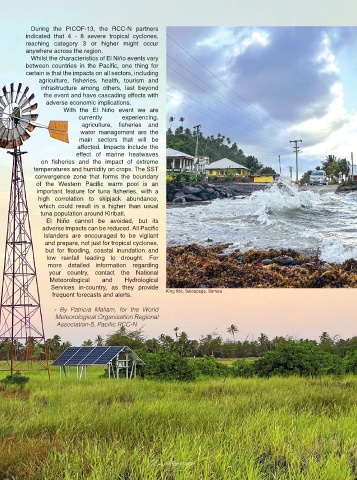
 Island  Countries,  with  a  focus  on  strengthening  food  Papua New Guinea, and Solomon Islands, which means   frequent forecasts and alerts.   King tide, Saleapaga, Samoa
 security in the Pacific with climate services. PICOF-13  that the combination of lower sea levels and warm seas
 is a joint event supported by the EU-funded Intra-ACP  may lead to coral bleaching in these countries. Coral   - By Patricia Mallam, for the World
 Climate Services and Related Applications Programme  bleaching may also occur in Tokelau, Tuvalu, Kiribati,   Meteorological Organisation Regional
 (Intra-ACP  ClimSA)  SPREP  and  the  Australian  and  Northern Cook Islands, and Marshall Islands.   Association-5, Pacific RCC-N


 Decca Water Reserve, Kiritimati Atoll, Kiribati


 Sponsored Content                                     Sponsored Content
                                                                                           Islands Business, November 2023  19

