


Page 16 - IB November 2023
P. 16
Regional Security                                                                                                                                                                              Regional Security


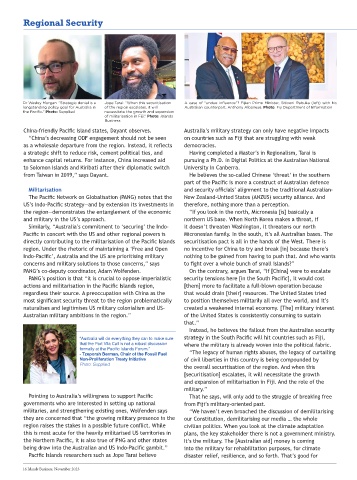
         Dr Wesley Morgan: “Strategic denial is a   Jope Tarai: “When this securitisation   A case of “undue influence”? Fijian Prime Minister, Sitiveni Rabuka (left) with his
         longstanding policy goal for Australia in   of the region escalates, it will   Australian counterpart, Anthony Albanese. Photo: Fiji Department of Information
         the Pacific.” Photo: Supplied  necessitate the growth and expansion
                                   of militarisation in Fiji.” Photo: Islands
                                   Business
         China-friendly Pacific Island states, Dayant observes.  Australia’s military strategy can only have negative impacts
          “China’s decreasing ODF engagement should not be seen   on countries such as Fiji that are struggling with weak
         as a wholesale departure from the region. Instead, it reflects   democracies.
         a strategic shift to reduce risk, cement political ties, and   Having completed a Master’s in Regionalism, Tarai is
         enhance capital returns. For instance, China increased aid   pursuing a Ph.D. in Digital Politics at the Australian National
         to Solomon Islands and Kiribati after their diplomatic switch   University in Canberra.
         from Taiwan in 2019,” says Dayant.                    He believes the so-called Chinese ‘threat’ in the southern
                                                             part of the Pacific is more a construct of Australian defence
          Militarisation                                     and security officials’ alignment to the traditional Australian-
          The Pacific Network on Globalisation (PANG) notes that the   New Zealand-United States (ANZUS) security alliance. And
         US’s Indo-Pacific strategy—and by extension its investments in   therefore, nothing more than a perception.
         the region—demonstrates the entanglement of the economic   “If you look in the north, Micronesia [is] basically a
         and military in the US’s approach.                  northern US base. When North Korea makes a threat, if
          Similarly, “Australia’s commitment to ‘securing’ the Indo-  it doesn’t threaten Washington, it threatens our north
         Pacific in concert with the US and other regional powers is   Micronesian family. In the south, it’s all Australian bases. The
         directly contributing to the militarisation of the Pacific Islands   securitisation pact is all in the hands of the West. There is
         region. Under the rhetoric of maintaining a ‘Free and Open   no incentive for China to try and break [in] because there’s
         Indo-Pacific’, Australia and the US are prioritising military   nothing to be gained from having to push that. And who wants
         concerns and military solutions to those concerns,” says   to fight over a whole bunch of small islands?”
         PANG’s co-deputy coordinator, Adam Wolfenden.         On the contrary, argues Tarai, “If [China] were to escalate
          PANG’s position is that “it is crucial to oppose imperialistic   security tensions here [in the South Pacific], it would cost
         actions and militarisation in the Pacific Islands region,   [them] more to facilitate a full-blown operation because
         regardless their source. A preoccupation with China as the   that would drain [their] resources. The United States tried
         most significant security threat to the region problematically   to position themselves militarily all over the world, and it’s
         naturalises and legitimises US military colonialism and US-  created a weakened internal economy. [The] military interest
         Australian military ambitions in the region.”       of the United States is consistently consuming to sustain
                                                             that.”
                                                               Instead, he believes the fallout from the Australian security
                           “Australia will do everything they can to make sure   strategy in the South Pacific will hit countries such as Fiji,
                           that the Port Vila Call is not a robust discussion   where the military is already woven into the political fabric.
                           formally at the Pacific Islands Forum.”
                           - Tzeporah Berman, Chair of the Fossil Fuel   “The legacy of human rights abuses, the legacy of curtailing
                           Non-Proliferation Treaty Initiative  of civil liberties in this country is being compounded by
                           Photo: Supplied
                                                             the overall securitisation of the region. And when this
                                                             [securitisation] escalates, it will necessitate the growth
                                                             and expansion of militarisation in Fiji. And the role of the
                                                             military.”
          Pointing to Australia’s willingness to support Pacific   That he says, will only add to the struggle of breaking free
         governments who are interested in setting up national   from Fiji’s military-oriented past.
         militaries, and strengthening existing ones, Wolfenden says   “We haven’t even broached the discussion of demilitarising
         they are concerned that “the growing military presence in the   our Constitution, demilitarising our media … the whole
         region raises the stakes in a possible future conflict. While   civilian politics. When you look at the climate adaptation
         this is most acute for the heavily militarised US territories in   plans, the key stakeholder there is not a government ministry.
         the Northern Pacific, it is also true of PNG and other states   It’s the military. The [Australian aid] money is coming
         being draw into the Australian and US Indo-Pacific gambit.”  into the military for rehabilitation purposes, for climate
          Pacific Islands researchers such as Jope Tarai believe   disaster relief, resilience, and so forth. That’s good for

        16 Islands Business, November 2023

