


Page 11 - IB November 2023
P. 11
Climate Change


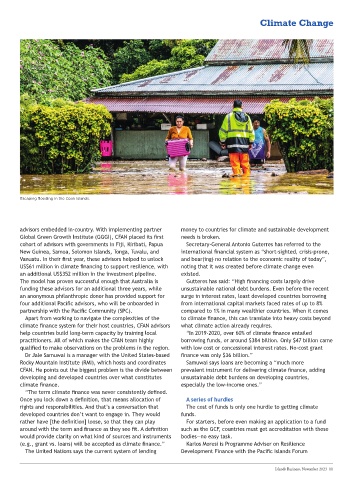
        Escaping flooding in the Cook Islands.


        advisors embedded in-country. With implementing partner   money to countries for climate and sustainable development
        Global Green Growth Institute (GGGI), CFAN placed its first   needs is broken.
        cohort of advisors with governments in Fiji, Kiribati, Papua   Secretary-General Antonio Guterres has referred to the
        New Guinea, Samoa, Solomon Islands, Tonga, Tuvalu, and   international financial system as “short-sighted, crisis-prone,
        Vanuatu. In their first year, these advisors helped to unlock   and bear(ing) no relation to the economic reality of today”,
        US$61 million in climate financing to support resilience, with   noting that it was created before climate change even
        an additional US$352 million in the investment pipeline.   existed.
        The model has proven successful enough that Australia is   Gutteres has said: “High financing costs largely drive
        funding these advisors for an additional three years, while   unsustainable national debt burdens. Even before the recent
        an anonymous philanthropic donor has provided support for   surge in interest rates, least developed countries borrowing
        four additional Pacific advisors, who will be onboarded in   from international capital markets faced rates of up to 8%
        partnership with the Pacific Community (SPC).       compared to 1% in many wealthier countries. When it comes
         Apart from working to navigate the complexities of the   to climate finance, this can translate into heavy costs beyond
        climate finance system for their host countries, CFAN advisors   what climate action already requires.
        help countries build long-term capacity by training local   “In 2019-2020, over 60% of climate finance entailed
        practitioners. All of which makes the CFAN team highly   borrowing funds, or around $384 billion. Only $47 billion came
        qualified to make observations on the problems in the region.  with low cost or concessional interest rates. No-cost grant
         Dr Jale Samuwai is a manager with the United States-based   finance was only $36 billion.”
        Rocky Mountain Institute (RMI), which hosts and coordinates   Samuwai says loans are becoming a “much more
        CFAN. He points out the biggest problem is the divide between   prevalent instrument for delivering climate finance, adding
        developing and developed countries over what constitutes   unsustainable debt burdens on developing countries,
        climate finance.                                    especially the low-income ones.”
         “The term climate finance was never consistently defined.
        Once you lock down a definition, that means allocation of   A series of hurdles
        rights and responsibilities. And that’s a conversation that   The cost of funds is only one hurdle to getting climate
        developed countries don’t want to engage in. They would   funds.
        rather have [the definition] loose, so that they can play   For starters, before even making an application to a fund
        around with the term and finance as they see fit. A definition   such as the GCF, countries must get accreditation with these
        would provide clarity on what kind of sources and instruments   bodies—no easy task.
        (e.g., grant vs. loans) will be accepted as climate finance.”   Karlos Moresi is Programme Adviser on Resilience
         The United Nations says the current system of lending   Development Finance with the Pacific Islands Forum


                                                                                           Islands Business, November 2023  11

