


Page 10 - IB November 2023
P. 10
THE LONG, HARD ROAD TO

                                  CLIMATE FINANCE


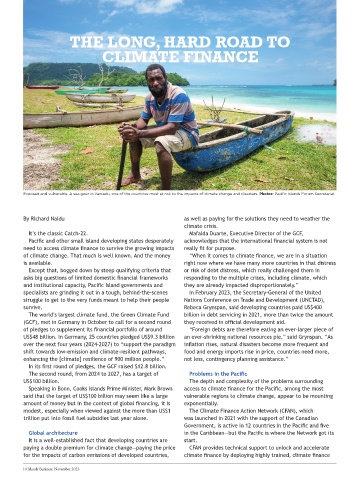
         Exposed and vulnerable. A sea goer in Vanuatu, one of the countries most at risk to the impacts of climate change and disasters. Photos: Pacific Islands Forum Secretariat


         By Richard Naidu                                    as well as paying for the solutions they need to weather the
                                                             climate crisis.
          It’s the classic Catch-22.                           Mafalda Duarte, Executive Director of the GCF,
          Pacific and other small island developing states desperately   acknowledges that the international financial system is not
         need to access climate finance to survive the growing impacts   really fit for purpose.
         of climate change. That much is well known. And the money   “When it comes to climate finance, we are in a situation
         is available.                                       right now where we have many more countries in that distress
          Except that, bogged down by steep qualifying criteria that   or risk of debt distress, which really challenged them in
         asks big questions of limited domestic financial frameworks   responding to the multiple crises, including climate, which
         and institutional capacity, Pacific Island governments and   they are already impacted disproportionately.”
         specialists are grinding it out in a tough, behind-the-scenes   In February 2023, the Secretary-General of the United
         struggle to get to the very funds meant to help their people   Nations Conference on Trade and Development (UNCTAD),
         survive.                                            Rebeca Grynspan, said developing countries paid US$400
          The world’s largest climate fund, the Green Climate Fund   billion in debt servicing in 2021, more than twice the amount
         (GCF), met in Germany in October to call for a second round   they received in official development aid.
         of pledges to supplement its financial portfolio of around   “Foreign debts are therefore eating an ever-larger piece of
         US$48 billion. In Germany, 25 countries pledged US$9.3 billion   an ever-shrinking national resources pie,” said Grynspan. “As
         over the next four years (2024-2027) to “support the paradigm   inflation rises, natural disasters become more frequent and
         shift towards low-emission and climate-resilient pathways,   food and energy imports rise in price, countries need more,
         enhancing the [climate] resilience of 900 million people.”  not less, contingency planning assistance.”
          In its first round of pledges, the GCF raised $12.8 billion.
          The second round, from 2024 to 2027, has a target of   Problems in the Pacific
         US$100 billion.                                       The depth and complexity of the problems surrounding
          Speaking in Bonn, Cooks Islands Prime Minister, Mark Brown   access to climate finance for the Pacific, among the most
         said that the target of US$100 billion may seem like a large   vulnerable regions to climate change, appear to be mounting
         amount of money but in the context of global financing, it is   exponentially.
         modest, especially when viewed against the more than US$1   The Climate Finance Action Network (CFAN), which
         trillion put into fossil fuel subsidies last year alone.   was launched in 2021 with the support of the Canadian
                                                             Government, is active in 12 countries in the Pacific and five
          Global architecture                                in the Caribbean—but the Pacific is where the Network got its
          It is a well-established fact that developing countries are   start.
         paying a double premium for climate change—paying the price   CFAN provides technical support to unlock and accelerate
         for the impacts of carbon emissions of developed countries,   climate finance by deploying highly trained, climate finance

        10 Islands Business, November 2023

