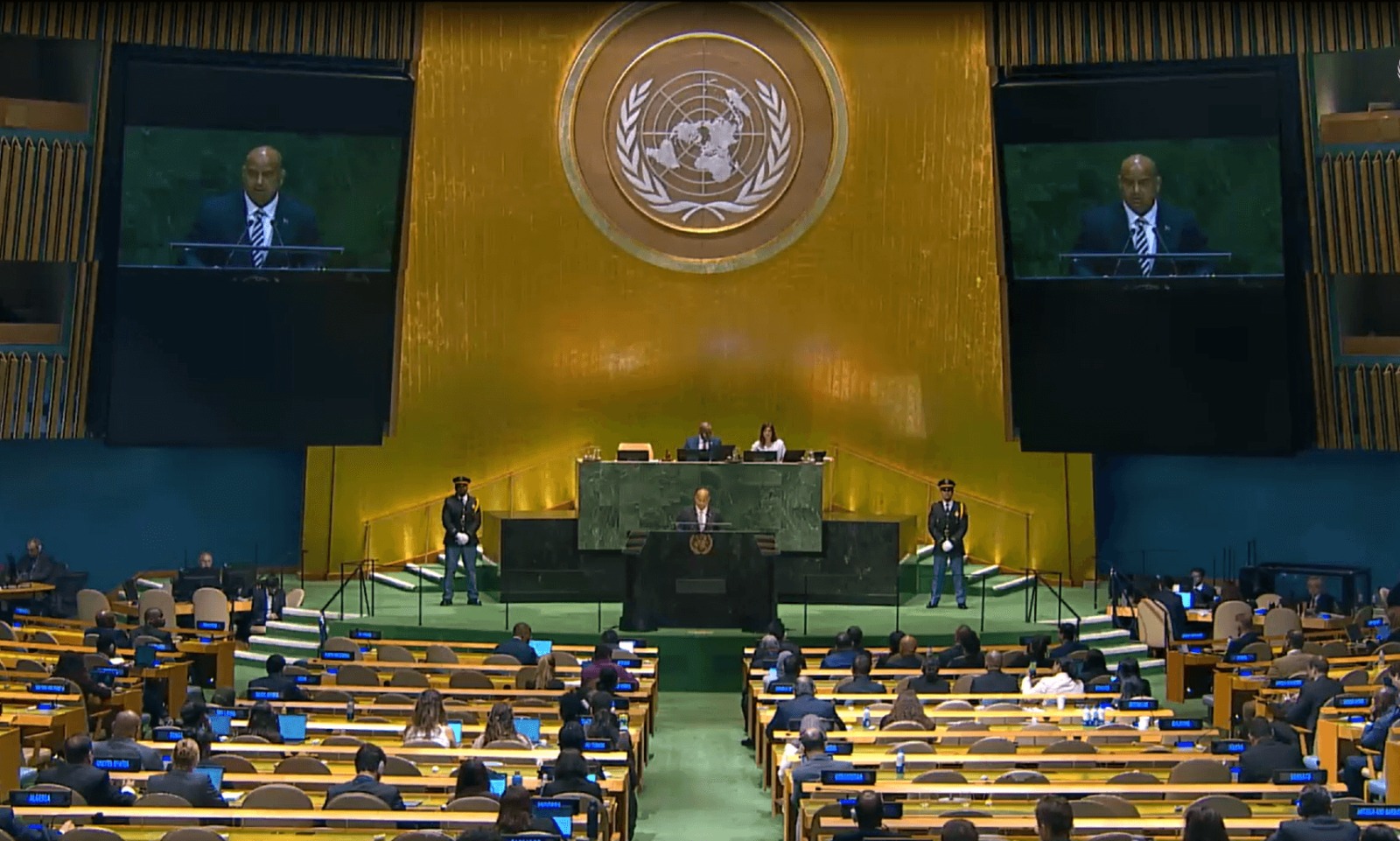
FROM September 22-26 and on September 28, member states of the United Nations were invited to deliver their annual high-level speeches at the UN General Assembly’s (UNGA) General Debate in New York.
This included the 12 Pacific Island Countries (PICs) that are UN members.
The topics they raised, the way they expressed support for multilateralism and for national and Pacific initiatives, the partner countries they mentioned by name and how they addressed conflicts tell us a lot about regional priorities, cooperation and geopolitics in the Pacific.
Although the speeches feature national differences, some regional patterns are evident: climate change and the oceans remain the most important issues for most PICs.
They reject geopolitical rivalry in their own region and strongly support multilateralism, but say little about global politics and conflicts.
And yet, perhaps most remarkable was the absence of climate change from Naoero’s speech and its announcement to withdraw from the International Criminal Court (ICC), which after all is overshadowed by geopolitics.
What is particularly striking is the clarity with which many PICs rejected power struggles in the Pacific. Palau’s President Surangel Whipps underlined that “the Pacific is our home, not a theatre for geopolitical competition”.
Noting that “small states are increasingly asked to choose”, Naoero’s President David Adeang stated that “Naoero will not be made to choose. We will work with every partner who respects our sovereignty and our right to decide our own future. That is not neutrality. It is independence.”
Not only has the tone of Pacific statements on geopolitical rivalry become more pronounced, but the number of PICs opposing geopolitical power struggles in their speeches has markedly increased from four in 2025 to nine in 2026 (see Table 1).
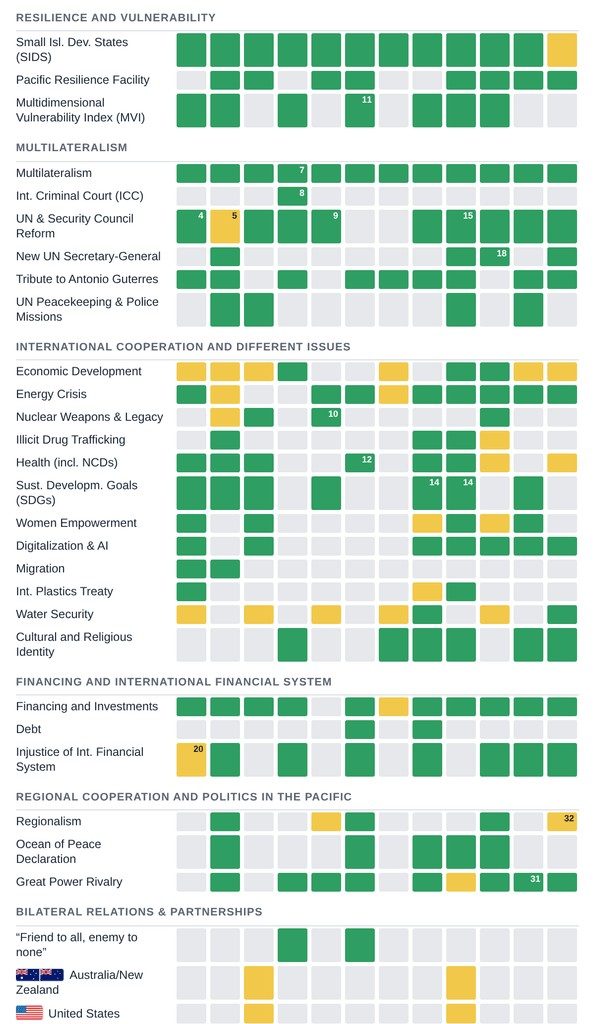
However, when addressing geopolitical rivalry, they avoid explicitly naming the actual players involved such as the US or China.
It is noteworthy that Palau’s President Whipps was the only Pacific leader to comment on China’s ballistic missile test that sparked controversy ahead of the Pacific Islands Forum (PIF) Leaders Meeting.
Concurrently, positive acknowledgement of traditional partners further declined significantly.
In fact, Japan and Germany were mentioned more often than the US, China, Australia or New Zealand.
This is even more remarkable given that many PICs highlighted the UN Climate PreCOP, co-hosted by Fiji, Tuvalu and Australia shortly after the General Debate.
The only clear exception to the tendency to rarely mention partners was Taiwan, which featured prominently in the speeches by the Marshall Islands, Palau and Tuvalu.
Unsurprisingly, climate change and ocean governance were central themes in the Pacific speeches.
Many PICs praised the UN Declaration on Sea-Level Rise, which was adopted at a high-level meeting on the sidelines of the General Debate.
Tuvalu’s Prime Minister Feleti Teo, whose country has campaigned for the declaration for years, described it as a “monumental and gratifying achievement”.
The declaration affirms that sea-level rise should not result in the loss of statehood and sovereignty.
Although its language remains vague, it represents significant progress on the legal continuity of statehood. Pacific leaders also used the General Debate to promote “Pacific-owned” initiatives like the Pacific Resilience Facility (PRF).
They emphasised their leadership in ocean governance, highlighting the entry into force of the Agreement on Biodiversity Beyond National Jurisdiction and that they were among the first signatories to the agreement.
Naoero, which spoke at the UN for the first time under its new name, undoubtedly delivered the most striking Pacific speech.
President Adeang was the only Pacific leader not to mention climate change. He also announced that Naoero will leave the ICC, just hours after US President Donald Trump slammed the Court as an “out-of-control institution” and an “anti-American tribunal” and called upon all nations to resign from “this rogue institution immediately” in his address to the Assembly.
This makes Naoero the only state at the Debate to follow Trump’s demand.
However, the Debate once again demonstrated that things are sometimes more complex than they appear.
In fact, Naoero also joined Tuvalu and Vanuatu in criticising sanctions against Cuba, thus implicitly protesting against the US.
This ambiguity resonates with Adeang’s statement that “Partnership does not mean agreement on everything.
It means standing together where interests align, and standing on principle where they do not.”
As strong advocates of multilateralism, the PICs emphasised the UN Charter and the principle of equality of states.
Many PICs paid tribute to the outgoing UN Secretary-General António Guterres in terms that extended beyond mere diplomatic routine.
Mathew Wale, the Prime Minister of the Solomon Islands, called Guterres a “true champion of multilateralism and of Small Island Developing States”, stressing that his repeated visits to the Pacific had shown the world “that the Pacific matters”.
Yet, Naoero’s withdrawal from the ICC, but also the frustration Adeang expressed with the international community over deep-sea mining, illustrate that Pacific support for multilateralism is not unconditional.
Many Pacific speeches focused even more intensely on their own region than in previous years.
As in many other regions, there appears to be a growing tendency to focus on internal matters.
Conversely, the PICs spoke out very little about wars and conflicts beyond their region, including Russia’s war of aggression against Ukraine and the war in Iran, although many PICs highlighted consequences such as the energy crisis. Notably, no Pacific nation declared solidarity with Israel this year.
Last year, by contrast, the Prime Ministers of Fiji and Papua New Guinea, Sitiveni Rabuka and James Marape, criticised Hamas and voiced their support for Israel.
As Sione Tekiteki points out, PIF decisions alone are “not always a reliable barometer of Pacific solidarity” and that the value of regionalism “becomes clearer when we follow what happens to regional positions” afterwards.
The PRF is a prime example of a regional initiative brought collectively to the UNGA by eight PICs.
This still leaves room to wonder why the Federated States of Micronesia, Naoero, Papua New Guinea and Samoa decided not to do so. The Forum’s Ocean of Peace Declaration offers another example.
A little over a year after its adoption, five PICs referred to it during their General Debate speeches, with Fiji, the Solomon Islands and Tonga doing so for the second consecutive year.
Addressing sensitive issues such as human rights violations in West Papua at the UNGA, like the Marshall Islands, the Solomon Islands and Vanuatu did this year, requires more courage than simply agreeing to their inclusion in a joint and more anonymous regional communiqué.
This constitutes a significant increase from 2025, when none of the Pacific speakers mentioned West Papua.
The PIF communiqué may serve as a regional reassurance, easing the way for PICs to raise the issue.
Meanwhile, in his statement on New Caledonia and sovereignty over the Matthew and Hunter Islands, Vanuatu’s Permanent Representative to the UN, Odo Tevi, offered a veritable diplomatic lesson, criticising France while simultaneously praising it as a champion of the international rules-based order and climate action.
Original article: https://devpolicy.org/what-the-pacific-unga-speeches-tell-us-about-geopolitics-and-regionalism-20261105/