
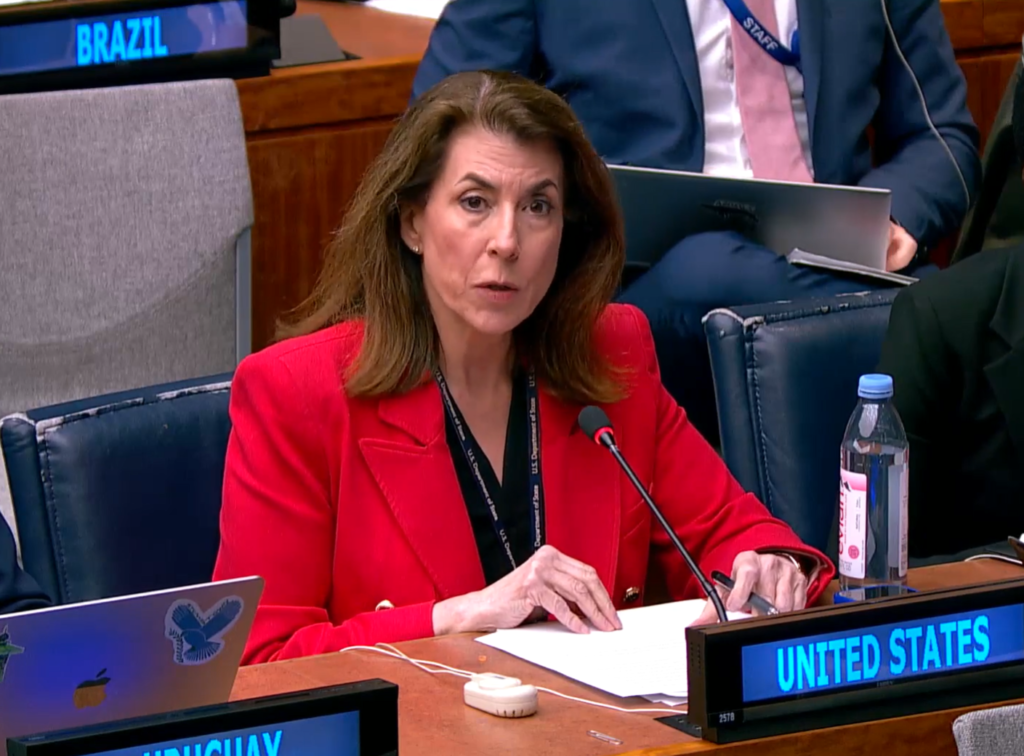
THE US has explicitly called for the UN Fourth Committee’s mandate to end, saying it has “outlived its original purpose”, and has attacked regional visits to the Pacific as “yearly junkets”, ramping up its annual opposition to decolonisation processes.
At the UN General Assembly’s Fourth Committee meeting on October 15, US Deputy Representative to the United Nations Tammy Bruce called for the termination of the Special Committee on Decolonisation, arguing its work was no longer necessary.
“The Special Committee has outlived its original purpose, with more than 80 former colonies having since joined the UN as member states,” Bruce said.
She criticised the committee’s annual consideration of decolonisation resolutions, saying it wasted UN time and resources.
“Revisiting the same texts every year wastes the UN’s time and resources, as do the Special Committee’s yearly junkets to resorts in the Caribbean and South Pacific,” she said.
Six of the 17 territories remaining on the UN list of non-self-governing territories are in the Pacific: American Samoa, French Polynesia, Guam, New Caledonia, Tokelau and Pitcairn.
The US also challenged the legal standing of key texts underpinning the international decolonisation process, including General Assembly Resolution 1514, adopted in 1960, which calls for an end to colonialism.
“These and earlier resolutions, including resolution 1514, are non-binding and do not necessarily reflect international law,” Bruce said.
Washington argued that independence should not be the only outcome of decolonisation, saying people in non-self-governing territories should be able to choose between independence, free association, integration with an administering state, or another political status freely determined by the people concerned.
“The Special Committee should not presume to speak for these peoples, or intervene in the internal affairs of a sovereign state and its relations with non-self-governing territories,” Bruce said.
However, Bruce also reaffirmed Washington’s disagreement with criticism of a US federal court ruling that blocked Guam’s planned self-determination plebiscite.
She reiterated the US position that it had a sovereign right to conduct military activities in accordance with its national security interests and international law.
The US further criticised the committee’s continued consideration of Puerto Rico, which the UN General Assembly removed from its list of non-self-governing territories in 1953 with Resolution 748.
Bruce accused the committee of becoming a platform for “ideological posturing” rather than focusing on the people it represents.
“It should go without saying the people of the remaining territories deserve better than to be considered as props in other governments’ political campaigns,” she said.
The US and Israel voted against all resolutions and decisions under the decolonisation agenda item at the October 15 meeting.
A resolution concerning non-self-governing territories received 160 votes in favour, with the US and Israel voting against it. Other resolutions drew more divided votes, including those on whether colonialism should include economic coercion and other contemporary practices.
Pacific churches reject US position
The Pacific Conference of Churches (PCC) has rejected the US call to end the committee’s mandate, arguing that decolonisation remains unfinished while six Pacific territories remain on the UN list.
In a statement issued on October 19, PCC General Secretary Reverend James Shri Bhagwan challenged Washington’s description of the committee’s regional visits as “yearly junkets”.
“Our people are not props, and our homes are not junkets,” Bhagwan said.
The PCC argued that the committee’s work remains necessary, with its regional seminars and visiting missions giving communities, churches, customary leaders, women, and young people opportunities to express their views directly to the United Nations.
It said that more than 80 former colonies had become UN member states, demonstrating the progress of decolonisation rather than a reason to end the process.
The PCC also argued that the right to self-determination remained central to international law and that territories should be able to choose their political futures through a genuine expression of their wishes.
It said the challenge in the Pacific was not that the UN committee refused to recognise different political arrangements, but that some administering powers had failed to allow genuine choices to take place.
The PCC also raised concerns about Guam, where a we federal court ruling blocked a planned plebiscite on political status.
It argued that Washington could not claim to support self-determination while the CHamoru people of Guam remained unable to exercise that right through the planned vote.
The church body called on UN member states to reject efforts to end or weaken the committee’s mandate and to support its visiting missions and regional seminars adequately.
It also urged the United States to cooperate with the committee and support a genuine self-determination process for the CHamoru people.
The PCC called on the administering powers, France, New Zealand, the United Kingdom and the United States, to agree on clear timelines to complete decolonisation before the end of the Fourth International Decade for the Eradication of Colonialism in 2030.
It further urged Pacific Islands Forum leaders to publicly reaffirm the region’s support for the six Pacific territories’ right to self-determination.
For the Pacific, the debate raises broader questions about regional solidarity, the role of international institutions, and peoples’ right to determine their own political futures.
While the US argues that the committee has outlived its purpose, the PCC maintains that its work remains necessary until the peoples of the remaining territories have freely determined their futures.


