
PACIFIC governments and development partners must invest in a modern regional fisheries surveillance centre to counter changing illegal fishing practices and wider maritime security threats, Solomon Islands Foreign Affairs Minister Rick Houenipwela said.
Houenipwela made the call in a keynote address at a Pacific Islands Forum Fisheries Agency (FFA) side event held alongside the 55th Pacific Islands Forum Leaders Meeting in Koror.
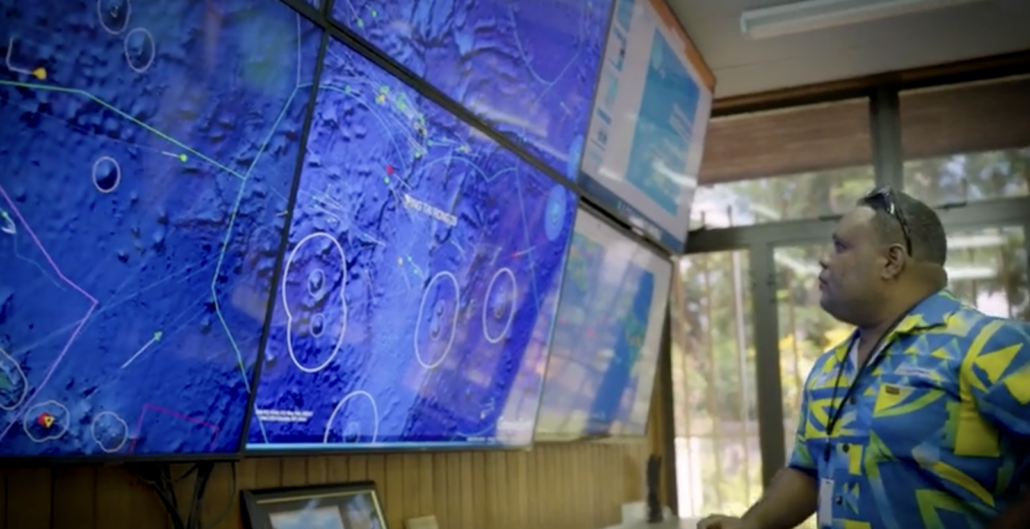
The Regional Fisheries Surveillance Centre (RFSC), based at FFA headquarters in Honiara, Solomon Islands, combines national authority with regional information, technology and operational support for the 17 FFA members.
“As the operational environment becomes more complex, the Centre must also evolve,” Houenipwela said.
“A future-fit RFSC will require resilient infrastructure, secure and modern technology, sustained access to surveillance assets, stronger analytical capability and continued investment in Pacific people.”
The side event, titled “Securing our Blue Pacific: Integrated Monitoring, Control and Surveillance and the future of the Regional Fisheries Surveillance Centre,” was co-hosted by the FFA and Palau’s Ministry of Agriculture, Fisheries and the Environment.
Pacific leaders, ministers, regional organisations, development partners and other guests discussed national action, regional cooperation and the investment needed to protect the region’s fisheries and wider maritime domain.
A central issue was the need to upgrade the RFSC facility in Honiara as the scale and complexity of regional monitoring, control and surveillance increase.
Houenipwela said the Centre had turned political unity and regional cooperation into practical support by maintaining a shared maritime picture, identifying risks and coordinating regional surveillance operations.
“The RFSC shows what Pacific regionalism looks like when it moves from commitment to implementation,” he said. “It brings together national sovereignty and regional solidarity.”
“It demonstrates that cooperation does not diminish our sovereign authority. Rather, it strengthens our ability to exercise that authority across the vast ocean spaces entrusted to us.”
FFA Director-General Noan David Pakop said the Centre maintained a near-real-time maritime domain awareness picture across the exclusive economic zones of the 17 FFA members and adjacent high seas.
“The RFSC stands as our collective shield,” Pakop said.
Regional fisheries surveillance success
In the past year, coordinated regional operations analysed more than 104,000 satellite detections and supported over 1,000 vessel boardings, he said.
The Centre provides members with information and risk analysis to guide the deployment of patrol vessels, aircraft and inspection teams, Pakop said.
The region has also recorded a reduction in the estimated value of tuna linked to illegal, unreported and unregulated fishing.
A 2016 quantification study estimated the annual value of tuna linked to illegal, unreported and unregulated fishing in the Pacific at about $616 million. A second study in 2021 placed the figure at approximately $333 million, a reduction of 46 per cent.
Pakop attributed the reduction to stronger regional surveillance, including greater use of satellite technology to monitor fishing activity across the Pacific.
He also cited improved information-sharing, coordinated surveillance operations and stronger national enforcement, while warning that the region could not become complacent.
“To sustain this success, we must develop a modern, fit-for-purpose RFSC equipped to manage growing volumes of surveillance data, electronic reporting and changes across the wider maritime domain,” he said.
Australia has committed initial financial support to expand the Centre’s infrastructure, technology, analytical capability and training facilities. Further investment from FFA members and development partners will be required to complete the upgrade and meet the region’s long-term surveillance needs.
Australia’s support also includes the Pacific Maritime Security Program, aerial surveillance, maritime domain technology, training and assistance to Pacific regional institutions.
Palau’s Minister for Agriculture, Fisheries and the Environment, Steven Victor, highlighted the importance of national leadership in fisheries monitoring, control and surveillance, as well as the challenges posed by resource and legal frameworks.
He said national enforcement, maritime coordination, regional surveillance systems and international partnerships worked together to support Palau’s response to fisheries and wider maritime risks.
The panel discussion focused on three connected parts of the regional surveillance effort: strong national action, regional partnership and the coordinating role of the RFSC.
The event featured a video showing how the Centre combines vessel-monitoring information, satellite detections, aerial surveillance and regional intelligence to support national enforcement and coordinated regional operations.


