WHILE the billions of dollars Australia is spending on submarines, fighting vehicles, drones and jets receive plenty of attention, less well understood is the investment being made into Australia’s military bases.
Infrastructure might not seem that exciting.
But these expensive weapons all need homes to go to.
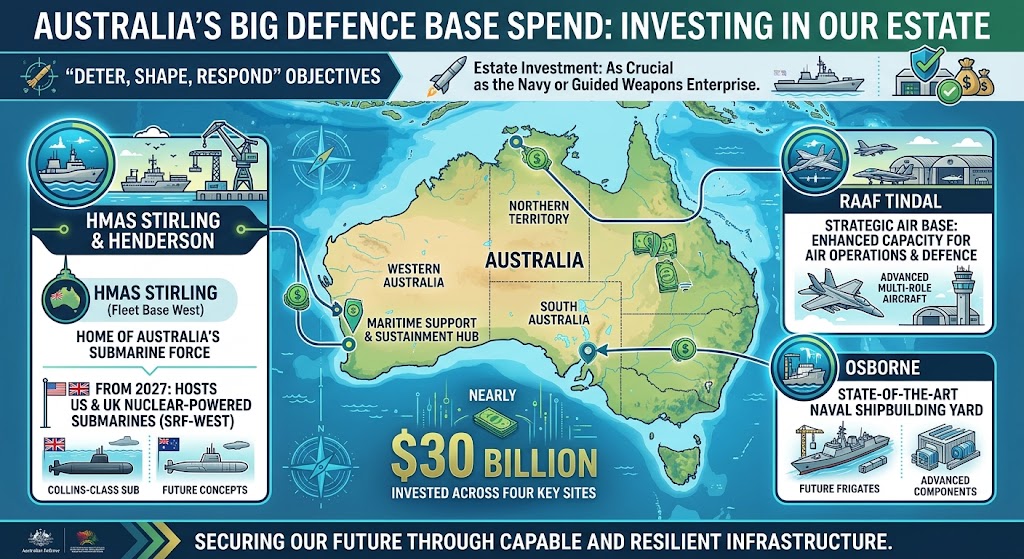
Australia’s investment into the Defence estate is no less crucial to its “deter, shape, respond” objectives than its expanding navy or its guided weapons and explosive ordnance enterprise.
Four key sites will receive nearly $AUD30 billion: HMAS Stirling and Henderson in Western Australia, Osborne in South Australia, and RAAF Tindal in the Northern Territory.
HMAS Stirling, otherwise known as Fleet Base West, is the home of Australia’s submarine force. From 2027, it will host US and then UK nuclear-powered submarines as part of Submarine Rotational Force-West (SRF-West).
The government is investing $AUD8 billion into the base to prepare it for the arrival of SRF-West, but renovation has been ongoing since at least 2018 to better serve the logistical requirements of Australia’s expanding surface fleet.
Since AUKUS was announced in 2021, the Oxley Wharf at the base has been extended, with Diamantia Wharf to be upgraded to accommodate nuclear-powered boats, and an extension to Parkes Wharf apparently shelved.
Shore facilities have been expanded to accommodate some 1000 US military personnel moving to the base, and the requirements involved in operating nuclear-powered submarines.
AUKUS is not just about military bases. Australia’s defence industry is seeing major cash injections as a result of the deal, particularly its submarine industry.
The submarine yards at Osborne in South Australia will be central to Australia’s ambition to build its own nuclear boats by the 2040s and have received $AUD8.5 billion of government investment.
Infrastructure might not seem that exciting. But these expensive weapons all need homes to go to.
Works at the site commenced in 2023, and cover three areas and a training campus.
Construction in Area 1, which will contain the yard’s fabrication hall, began in 2025.
The main change visible from space is what will be Osborne’s production demonstration facilities, where building methods will be tested before turning to full-scale. Ground was broken in Area 2 in 2026, which will contain workshops and warehouses.
Area 3, which will begin construction next year, is to the north of the complex and is where the new boats will be prepared in a consolidation hall before proceeding to a launching drydock.
While the skills campus will open for students in 2028, Areas 1, 2, and 3 are estimated for completion in around 2035, 2036, and 2039 respectively.
The Henderson Defence Precinct south of Perth, Western Australia, will likewise be a key piece of infrastructure for Australia’s future navy.
Australia is investing more than $AUD12 billion in the site to greatly expand its role in continuous shipbuilding and sustainment, including for nuclear-powered submarines.
While improvements have been made to the fabrication and support elements of the precinct, AUKUS-related construction is not yet being undertaken at Osborne.
The boundaries of the new precinct were decided in August 2026, so major construction could begin next year.
Indeed, if Australia is to receive its first nuclear-powered boat by the early 2030s, construction of this sustainment facility must proceed at pace. Estimates are already suggesting costs will reach $AUD25 billion over the next decade.
Not everything is about submarines. Aircraft also need lots of on-the-ground support. Australian air bases have been upgraded to play a greater role in hosting American forces. Canberra’s impulse to further integrate its defence with Washington goes beyond undersea warfare.
RAAF Tindal in the Northern Territory is a telling example.
Since 2020, $AUD1.6 billion has been invested to lengthen the runway, expand fuel and munitions storage, build new hangars and command and control infrastructure.
Tindal now hosts Australia’s growing fleet of Triton maritime surveillance drones, and has runways long enough to land American B-52 bombers.
Talks this week between Defence Minister Richard Marles and US Secretary of Defence Pete Hegseth emphasised a need to “swiftly” invest in Australian air force bases in a sign that the importance of facilities like Tindal will grow.
How these installations grow and develop in the coming decade is vital to Australia’s defence strategy.
While basing is not as exciting as submarines or aircraft, without places to be maintained and sustained, these weapons platforms cannot fulfil their roles. Given the amount of money involved in improving Australia’s defence infrastructure, these projects also require scrutiny.
Original article: https://www.lowyinstitute.org/the-interpreter/australia-s-usd30-billion-base-boom-needs-scrutiny-too?utm_campaign=95130076-