
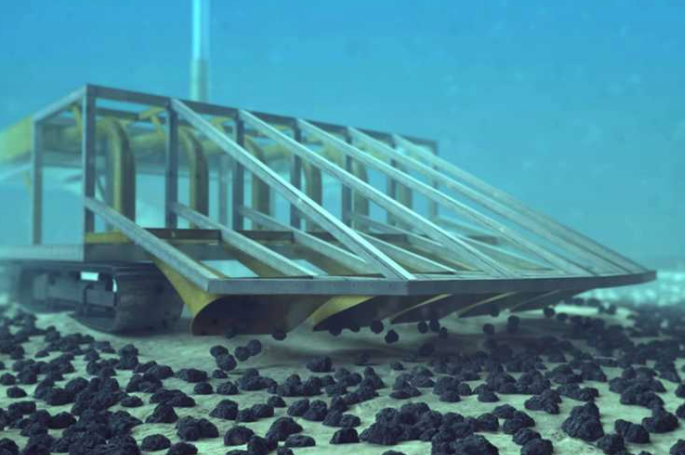
AN American company seeking to mine polymetallic nodules in the South Pacific has been forced to backtrack on claims of scientific and commercial backing after major UK research institutions and Asian metals companies disavowed its regulatory filing.
An AFP investigation revealed that American Deep Sea Minerals (ADSM) told the US National Oceanic and Atmospheric Administration (NOAA) that interest in collaboration was “strong” among the UK’s Natural History Museum, the University of Southampton, and the National Oceanography Centre.
All three institutions told AFP they had never been approached by the company and had no ties to the project.
University of Southampton marine ecologist Jon Copley said the institution had zero interaction with ADSM and would not collaborate with it, noting it would be “effectively illegal” under the United Kingdom’s international treaty obligations to assist seabed mining in international waters.
The Natural History Museum asked for its name to be removed, while the National Oceanography Centre confirmed it had granted no permission to be cited.
ADSM is targeting a 100,000-square-kilometre tract in the South Penrhyn Basin, wedged between the exclusive economic zones of the Cook Islands, Kiribati and French Polynesia—a region it claims holds “exceptionally high” concentrations of cobalt alongside copper, nickel and manganese.
The firm’s filing also listed Japanese materials giant Sumitomo and leading refiner Korea Zinc under “prospective investor groups” capable of processing and marketing the nodules.
Both companies also distanced themselves from the bid, with Sumitomo stating it was “not acquainted” with ADSM at all and Korea Zinc confirming it is not an investor.
Presented with the denials, ADSM told AFP it would file a written clarification with NOAA confirming no relationship exists with the UK institutions and acknowledging its wording around Sumitomo and Korea Zinc could have been clearer.
The controversy underscores mounting friction over unilateral US seabed licensing in the Pacific. Washington is not among the 171 member states of the Jamaica-based International Seabed Authority (ISA), which has yet to finalise its global mining code.
ADSM and four other firms, including The Metals Company, are invoking the US Deep Seabed Hard Mineral Resources Act to seek permits directly from NOAA, which deemed ADSM’s application “fully compliant” in June despite fierce regional warnings over marine ecological harm.

