
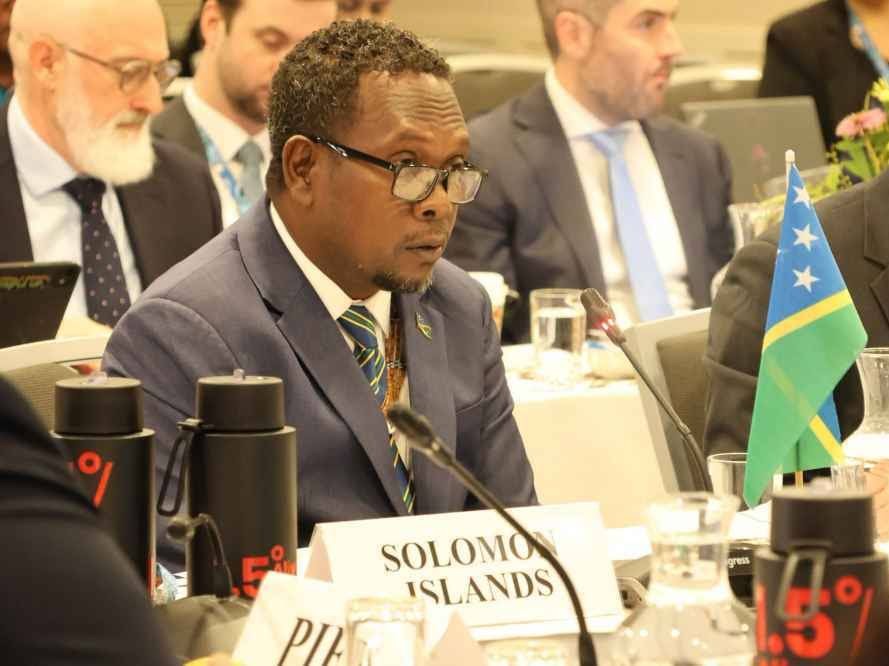
SOLOMON Islands Climate Change Minister Wayne Ghemu has called on global financial institutions to streamline and accelerate disbursements to Pacific Island nations before disasters strike.
Speaking at the Moana Blue Pacific Pavilion during a panel hosted by the Pacific Catastrophe Risk Insurance Company (PCRIC) in Antalya, Turkey, Ghemu emphasised that the real impact of climate funding depends directly on how quickly it is delivered. The panel was titled “Finance That Reaches the Pacific: Connecting Loss and Damage.”
Ghemu used Tropical Cyclone Maila, a Category 5 system that devastated parts of the Solomon Sea in April 2026, to illustrate the problem. Simbo Island in Western Province was hardest hit, affecting roughly 2,247 residents, displacing 268 people, and contaminating vital groundwater supplies.
He said relief efforts gained rapid momentum after PCRIC disbursed USD$500,000 to the Solomon Islands government within 10 days of the disaster.
“It arrived when it was needed, and it did exactly what it was designed to do,” Ghemu said. “The value of a dollar is shaped by timing.”
He also highlighted local microinsurance initiatives, noting that the Central Bank’s TrigaCash initiative compensated all 35 policyholders within two weeks of the cyclone.
Ghemu stressed that while rapid insurance payouts provide cash on hand in the short term, rebuilding essential infrastructure—including schools, clinics, housing, and water systems—requires sustained funding across the entire disaster management cycle. He outlined layers including the Global Shield initiative, which subsidises insurance premiums through PCRIC; the Pacific Resilience Facility, which provides direct grants for community resilience; PCRIC’s rapid liquidity for emergency expenses; and the Fund for Responding to Loss and Damage, which supports long-term reconstruction.
The minister warned that complicated processes, complex project-preparation requirements, and multi-year reviews by international funding bodies continue to undermine climate financing objectives.
“By the time funds get the green light, the cyclone has passed, costs inflate, and the planned project no longer meets community needs,” he stated. “Finance arriving after the moment of need fails its purpose.”
With the Pacific cyclone season beginning in November, Ghemu urged global financial institutions to establish pre-agreed hand-off protocols immediately.
“Maila showed it can be done,” “Let us make it the normal way the Pacific is supported, not the exception.”