


Page 28 - IB April 2023
P. 28
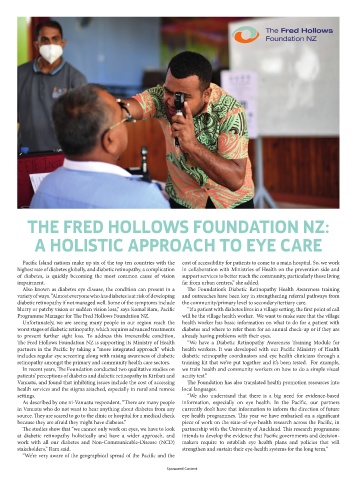
THE FRED HOLLOWS FOUNDATION NZ:

            A HOLISTIC APPROACH TO EYE CARE


        Pacific Island nations make up six of the top ten countries with the   cost of accessibility for patients to come to a main hospital. So, we work
       highest rate of diabetes globally, and diabetic retinopathy, a complication   in collaboration with Ministries of Health on the prevention side and
       of diabetes, is quickly becoming the most common cause of vision   support services to better reach the community, particularly those living
       impairment.                                          far from urban centres,” she added.
        Also known as diabetes eye disease, the condition can present in a   The Foundation’s Diabetic Retinopathy Health Awareness training
       variety of ways. “Almost everyone who has diabetes is at risk of developing   and outreaches have been key in strengthening referral pathways from
       diabetic retinopathy if not managed well. Some of the symptoms include   the community/primary level to secondary/tertiary care.
       blurry or patchy vision or sudden vision loss,” says Komal Ram, Pacific   “If a patient with diabetes lives in a village setting, the first point of call
       Programme Manager for The Fred Hollows Foundation NZ.   will be the village health worker.  We want to make sure that the village
        Unfortunately, we are seeing many people in our region reach the   health worker has basic information on what to do for a patient with
       worst stages of diabetic retinopathy, which requires advanced treatments   diabetes and where to refer them for an annual check-up or if they are
       to prevent further sight loss. To address this irreversible condition,   already having problems with their eyes.
       The Fred Hollows Foundation NZ is supporting its Ministry of Health   “We have a Diabetic Retinopathy Awareness Training Module for
       partners in the Pacific by taking a “more integrated approach” which   health workers. It was developed with our Pacific Ministry of Health
       includes regular eye screening along with raising awareness of diabetic   diabetic retinopathy coordinators and eye health clinicians through a
       retinopathy amongst the primary and community health care sectors.  training kit that we’ve put together and it’s been tested.  For example,
        In recent years, The Foundation conducted two qualitative studies on   we train health and community workers on how to do a simple visual
       patients’ perceptions of diabetes and diabetic retinopathy in Kiribati and   acuity test.”
       Vanuatu, and found that inhibiting issues include the cost of accessing   The Foundation has also translated health promotion resources into
       health services and the stigma attached, especially in rural and remote   local languages.
       settings.                                              “We  also  understand  that  there  is  a  big  need  for  evidence-based
        As described by one ni-Vanuatu respondent, “There are many people   information, especially on eye health. In the Pacific, our partners
       in Vanuatu who do not want to hear anything about diabetes from any   currently don’t have that information to inform the direction of future
       source. They are scared to go to the clinic or hospital for a medical check   eye health programmes. This year we have embarked on a significant
       because they are afraid they might have diabetes.”   piece of work on the state-of-eye-health research across the Pacific, in
        The studies show that “we cannot only work on eyes, we have to look   partnership with the University of Auckland. This research programme
       at diabetic retinopathy holistically and have a wider approach, and   intends to develop the evidence that Pacific governments and decision-
       work with all our diabetes and Non-Communicable-Disease (NCD)   makers require to establish eye health plans and policies that will
       stakeholders,” Ram said.                             strengthen and sustain their eye-health systems for the long term.”
        “We’re very aware of the geographical spread of the Pacific and the

        28 Islands Business, April 2023                Sponsored Content

