


Page 17 - Islands Business October 2022
P. 17
Connectedness important in preventing


                  depression in Pacific adolescents


        A  new  study  uses  network  analysis  to  demonstrate  how   the University of Melbourne, and Nottingham Trent University
       connectedness  with  family,  friends,  and  school  can  prevent   were able to draw on high-quality data from the world’s largest
       depression in Pacific adolescents.                     longitudinal study of Pacific peoples.
        Youth  mental  health  in  New  Zealand  is  declining  and   This study builds on the important work conducted by the
       the  impact  on  Pacific  youth,  particularly  young  women,  is   AUT Pacific Islands Families Study, which tracks the health and
       disproportionate.                                      development of New Zealand-Pacific children. It has collected
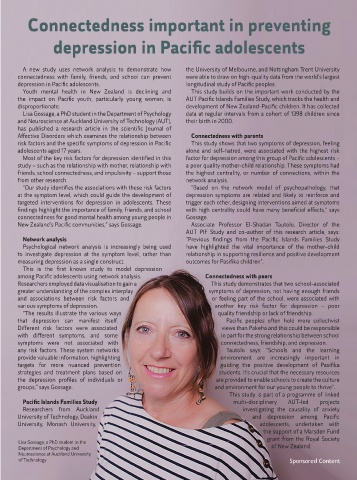
        Lisa Gossage, a PhD student in the Department of Psychology   data at regular intervals from a cohort of 1398 children since
       and Neuroscience at Auckland University of Technology (AUT),   their birth in 2000.
       has  published  a  research  article  in  the  scientific  Journal  of
       Affective Disorders which examines the relationship between   Connectedness with parents
       risk factors and the specific symptoms of depression in Pacific   This study shows that two symptoms of depression, feeling
       adolescents aged 17 years.                             alone  and  self-hatred,  were  associated  with  the  highest  risk
        Most of the key risk factors for depression identified in this   factor for depression among this group of Pacific adolescents –
       study – such as the relationship with mother, relationship with   a poor quality mother-child relationship. These symptoms had
       friends, school connectedness, and impulsivity – support those   the  highest  centrality,  or  number  of  connections,  within  the
       from other research.                                   network analysis.
        “Our study identifies the associations with these risk factors   “Based  on  the  network  model  of  psychopathology,  that
       at the symptom level, which could guide the development of   depression symptoms are related and likely to reinforce and
       targeted  interventions  for  depression  in  adolescents.  These   trigger each other, designing interventions aimed at symptoms
       findings highlight the importance of family, friends, and school   with high centrality could have many beneficial effects,” says
       connectedness for good mental health among young people in   Gossage.
       New Zealand’s Pacific communities,” says Gossage.       Associate  Professor  El-Shadan  Tautolo,  Director  of  the
                                                              AUT  PIF  Study  and  co-author  of  this  research  article,  says:
        Network analysis                                      “Previous  findings  from  the  Pacific  Islands  Families  Study
        Psychological  network  analysis  is  increasingly  being  used   have  highlighted  the  vital  importance  of  the  mother-child
       to  investigate  depression  at  the  symptom  level,  rather  than   relationship in supporting resilience and positive development
       measuring depression as a single construct.            outcomes for Pasifika children”.
        This  is  the  first  known  study  to  model  depression
       among Pacific adolescents using network analysis.            Connectedness with peers
       Researchers employed data visualisation to gain a              This study demonstrates that two school-associated
       greater understanding of the complex interplay                symptoms of depression, not having enough friends
       and  associations  between  risk  factors  and                 or feeling part of the school, were associated with
       various symptoms of depression.                                 another  key  risk  factor  for  depression  –  poor
        “The results illustrate the various ways                        quality friendship or lack of friendship.
       that  depression  can  manifest  itself.                            Pacific  peoples  often  hold  more  collectivist
       Different  risk  factors  were  associated                        views than Pakeha and this could be responsible
       with  different  symptoms,  and  some                             in part for the strong relationship between school
       symptoms  were  not  associated  with                             connectedness, friendship, and depression.
       any risk factors. These system networks                             Tautolo  says:  “Schools  and  the  learning
       provide valuable information, highlighting                        environment  are  increasingly  important  in
       targets  for  more  nuanced  prevention                           guiding  the  positive  development  of  Pasifika
       strategies  and  treatment  plans  based  on                     students. It’s crucial that the necessary resources
       the  depression  profiles  of  individuals  or                  are provided to enable schools to create the culture
       groups,” says Gossage.                                          and environment for our young people to thrive”.
                                                                            This study is part of a programme of linked
        Pacific Islands Families Study                                       multi-disciplinary   AUT-led   projects
        Researchers  from  Auckland                                             investigating  the  causality  of  anxiety
       University of Technology, Deakin                                            and  depression  among  Pacific
       University,  Monash  University,                                               adolescents,  undertaken  with
                                                                                       the support of a Marsden Fund
                                                                                        grant from the Royal Society
       Lisa Gossage, a PhD student in the
       Department of Psychology and                                                      of New Zealand.
       Neuroscience at Auckland University
       of Technology                                                                           Sponsored Content
                                                                                            Islands Business, October 2022  17

