


Page 15 - Islands Business October 2022
P. 15
Energy


       when they have surplus, which they should, given the massive   F$10,000 cash rebate per electric vehicle purchased by local
       solar farm that they’re putting in with help from KOICA. So   businesses and individuals.
       that’s just a start and basically, these systems can be rolled   A prevailing high cost of fossil fuels may also force many to
       out anywhere and we look forward to doing it,” Reddaway   switch.
       said.                                                  “I charge EVs all the time and still get F$200 monthly bill.
         The EV charger was launched by UNDP’s Deputy Resident   Here, you spend $200 a week on fuel alone,” said Reddaway.
       Representative, Yemesrach Workie, who described the project   EVs come with different battery sizes but a fully charged
       as “transformative” and one that could be replicated in any   battery, according to Reddaway, is enough to drive for up to
       country across the Pacific.                          150km.
         “We envisage that this project is going to be very catalytic   “In reality, these chargers are not actually for daily use.
       for a strong e-mobility uptake in Fiji,” she said.    They’re for when you’ve done 150km or 120km and you’re
         “It is setting the scene for us and has a positive spill over   coming in to charge. You get 6km every two minutes, so
       effect, we believe, in the maritime transport sector as well,   full charge will depend on the battery size. So basically the
       not only in land transport. We hope that in the very near   takeaway is, in this car, if you drive to Nadi, you stopped in
       future, these charging systems we see here will be part of the   Sigatoka and charge for 25 minutes, it will get you to Nadi and
       makeup of port site charging infrastructure, helping power   will cost you $12,” Reddaway said.
       electric boats around Fiji. So, we really have huge ambition   Switch Network plans to have five chargers installed on Viti
       for this project to move forward,” Workie added.     Levu by December, and to become an EV import dealer and
         EVs are expected to soon become serious contenders to   work with tourism companies to help them switch to EV-based
       fossil fuel-based vehicles, with the availability now of charg-  fleet.
       ing facilities complementing relevant government subsidies
       such as zero rate VAT and duty free for all EV imports, plus   editor@islandsbusiness.com


                   DECARBONISING TRANSPORT


                         HYDROGEN FUELLED VEHICLES ARE NEXT
                                                           By Samantha Magick


                                                            While electric vehicles are only just entering Pacific Island
                                                           markets, Tokyo is working towards an ambitious plan that
                                                           would see a decarbonised society with net zero CO2 emissions
                                                           by 2050. Increasing the number of vehicles powered through
                                                           green hydrogen energy is key to its success.
                                                            Tokyo’s strategy is a response to climate change and the
                                                           need to stablise energy supplies. If it remains on deadline, it
                                                           will see the Tokyo Metropolitan Government (TMG) halve its
                                                           2020 level of greenhouse gas emissions by 2030.
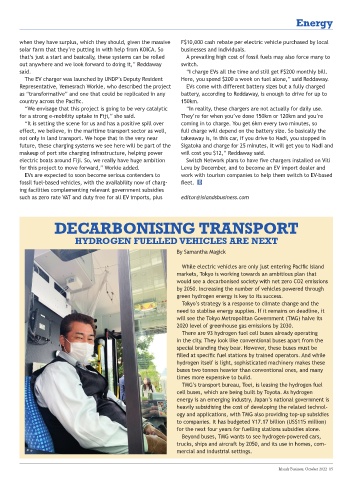
                                                            There are 93 hydrogen fuel cell buses already operating
                                                           in the city. They look like conventional buses apart from the
                                                           special branding they bear. However, these buses must be
                                                           filled at specific fuel stations by trained operators. And while
                                                           hydrogen itself is light, sophisticated machinery makes these
                                                           buses two tonnes heavier than conventional ones, and many
                                                           times more expensive to build.
                                                            TMG’s transport bureau, Toei, is leasing the hydrogen fuel
                                                           cell buses, which are being built by Toyota. As hydrogen
                                                           energy is an emerging industry, Japan’s national government is
                                                           heavily subsidising the cost of developing the related technol-
                                                           ogy and applications, with TMG also providing top-up subsidies
                                                           to companies. It has budgeted ¥17.17 billion (US$115 million)
                                                           for the next four years for fuelling stations subsidies alone.
                                                            Beyond buses, TMG wants to see hydrogen-powered cars,
                                                           trucks, ships and aircraft by 2050, and its use in homes, com-
                                                           mercial and industrial settings.


                                                                                            Islands Business, October 2022  15

