


Page 38 - IB September 2024
P. 38
Art                                                                                                                                                                                                                 Art


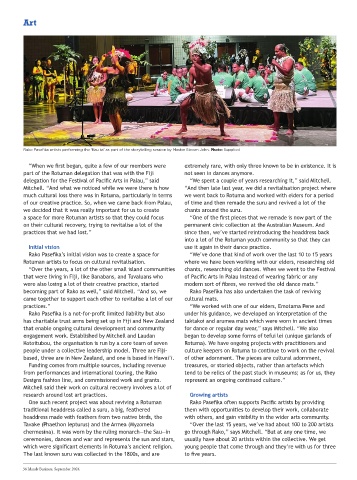
         Rako Pasefika artists performing the ‘Kau ta’ as part of the storytelling session by Master Steven John. Photo: Supplied

          “When we first began, quite a few of our members were   extremely rare, with only three known to be in existence. It is
         part of the Rotuman delegation that was with the Fiji   not seen in dances anymore.
         delegation for the Festival of Pacific Arts in Palau,” said   “We spent a couple of years researching it,” said Mitchell.
         Mitchell. “And what we noticed while we were there is how   “And then late last year, we did a revitalisation project where
         much cultural loss there was in Rotuma, particularly in terms   we went back to Rotuma and worked with elders for a period
         of our creative practice. So, when we came back from Palau,   of time and then remade the suru and revived a lot of the
         we decided that it was really important for us to create   chants around the suru.
         a space for more Rotuman artists so that they could focus   “One of the first pieces that we remade is now part of the
         on their cultural recovery, trying to revitalise a lot of the   permanent civic collection at the Australian Museum. And
         practices that we had lost.”                        since then, we’ve started reintroducing the headdress back
                                                             into a lot of the Rotuman youth community so that they can
          Initial vision                                     use it again in their dance practice.
          Rako Pasefika’s initial vision was to create a space for   “We’ve done that kind of work over the last 10 to 15 years
         Rotuman artists to focus on cultural revitalisation.   where we have been working with our elders, researching old
          “Over the years, a lot of the other small island communities   chants, researching old dances. When we went to the Festival
         that were living in Fiji, like Banabans, and Tuvaluans who   of Pacific Arts in Palau instead of wearing fabric or any
         were also losing a lot of their creative practice, started   modern sort of fibres, we revived the old dance mats.”
         becoming part of Rako as well,” said Mitchell. “And so, we   Rako Pasefika has also undertaken the task of reviving
         came together to support each other to revitalise a lot of our   cultural mats.
         practices.”                                           “We worked with one of our elders, Emotama Pene and
          Rako Pasefika is a not-for-profit limited liability but also   under his guidance, we developed an interpretation of the
         has charitable trust arms being set up in Fiji and New Zealand   taktakoi and arumea mats which were worn in ancient times
         that enable ongoing cultural development and community   for dance or regular day wear,” says Mitchell. “We also
         engagement work. Established by Mitchell and Laudan   began to develop some forms of tefui lei (unique garlands of
         Kotoitubou, the organisation is run by a core team of seven   Rotuma). We have ongoing projects with practitioners and
         people under a collective leadership model. Three are Fiji-  culture keepers on Rotuma to continue to work on the revival
         based, three are in New Zealand, and one is based in Hawai’i.   of other adornment. The pieces are cultural adornment,
          Funding comes from multiple sources, including revenue   treasures, or storied objects, rather than artefacts which
         from performances and international touring, the Rako   tend to be relics of the past stuck in museums; as for us, they
         Designs fashion line, and commissioned work and grants.   represent an ongoing continued culture.”
         Mitchell said their work on cultural recovery involves a lot of
         research around lost art practices.                   Growing artists
          One such recent project was about reviving a Rotuman   Rako Pasefika often supports Pacific artists by providing
         traditional headdress called a suru, a big, feathered   them with opportunities to develop their work, collaborate
         headdress made with feathers from two native birds, the   with others, and gain visibility in the wider arts community.
         Tavake (Phaethon lepturus) and the Armea (Myzomela    “Over the last 15 years, we’ve had about 100 to 200 artists
         chermesina). It was worn by the ruling monarch—the Sau—in   go through Rako,” says Mitchell. “But at any one time, we
         ceremonies, dances and war and represents the sun and stars,   usually have about 20 artists within the collective. We get
         which were significant elements in Rotuma’s ancient religion.   young people that come through and they’re with us for three
         The last known suru was collected in the 1800s, and are   to five years.

        38 Islands Business, September 2024

