


Page 39 - IB September 2024
P. 39
Art                                                                                                     Art


         “The intention is that we grow artists, we develop them
        so that they’re strong and confident enough to then carry on
        with their own careers. We’re probably on our fifth cycle of
        young people now. So currently, our team of now is about 15
        that are spread out throughout Fiji, Rotuma, New Zealand and
        Sydney.
         “Every three to five years is another cycle of young people
        that come through. They grow their practice and then they
        move on to their own individual careers or create their own
        companies. We’ve had some really successful artists that have
        gone on and done their own thing, which is our aim.
         “Our artists are based predominantly in Suva, but we also
        have artists out in Nadi, Rotuma, Auckland, Brisbane, Sydney,
        and Hawaii. They are primarily of Rotuman, Niuean, Samoan,
        Tokelaun, Tuvalu, and Fijian descent. We also have very strong
        connection with our artists based in Tahiti and Hawaii.”
         They tour extensively through Australia and New Zealand,
        have toured through the United States and Europe, and have a
        tour planned in Hawaii and Japan next year.
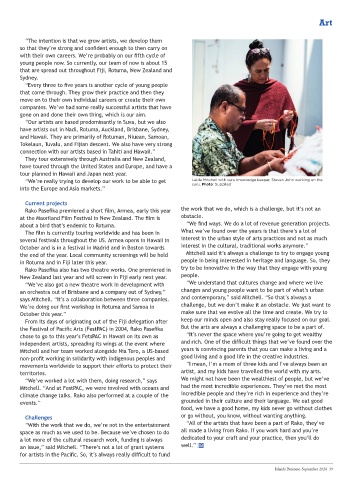
         “We’re really trying to develop our work to be able to get   Letila Mitchell with suru knowledge keeper, Steven John working on the
                                                                suru. Photo: Supplied
        into the Europe and Asia markets.”
         Current projects
         Rako Pasefika premiered a short film, Armea, early this year   the work that we do, which is a challenge, but it’s not an
        at the Maoriland Film Festival in New Zealand. The film is   obstacle.
        about a bird that’s endemic to Rotuma.                “We find ways. We do a lot of revenue generation projects.
         The film is currently touring worldwide and has been in   What we’ve found over the years is that there’s a lot of
        several festivals throughout the US. Armea opens in Hawaii in   interest in the urban style of arts practices and not as much
        October and is in a festival in Madrid and in Boston towards   interest in the cultural, traditional works anymore.”
        the end of the year. Local community screenings will be held   Mitchell said it’s always a challenge to try to engage young
        in Rotuma and in Fiji later this year.              people in being interested in heritage and language. So, they
         Rako Pasefika also has two theatre works. One premiered in   try to be innovative in the way that they engage with young
        New Zealand last year and will screen in Fiji early next year.  people.
         “We’ve also got a new theatre work in development with   “We understand that cultures change and where we live
        an orchestra out of Brisbane and a company out of Sydney,”   changes and young people want to be part of what’s urban
        says Mitchell. “It’s a collaboration between three companies.   and contemporary,” said Mitchell. “So that’s always a
        We’re doing our first workshop in Rotuma and Samoa in   challenge, but we don’t make it an obstacle. We just want to
        October this year.”                                 make sure that we evolve all the time and create. We try to
         From its days of originating out of the Fiji delegation after   keep our minds open and also stay really focused on our goal.
        the Festival of Pacific Arts (FestPAC) in 2004, Rako Pasefika   But the arts are always a challenging space to be a part of.
        chose to go to this year’s FetsPAC in Hawaii on its own as   “It’s never the space where you’re going to get wealthy
        independent artists, spreading its wings at the event where   and rich. One of the difficult things that we’ve found over the
        Mitchell and her team worked alongside Nia Tero, a US-based   years is convincing parents that you can make a living and a
        non-profit working in solidarity with indigenous peoples and   good living and a good life in the creative industries.
        movements worldwide to support their efforts to protect their   “I mean, I’m a mom of three kids and I’ve always been an
        territories.                                        artist, and my kids have travelled the world with my arts.
         “We’ve worked a lot with them, doing research,” says   We might not have been the wealthiest of people, but we’ve
        Mitchell. “And at FestPAC, we were involved with oceans and   had the most incredible experiences. They’ve met the most
        climate change talks. Rako also performed at a couple of the   incredible people and they’re rich in experience and they’re
        events.”                                            grounded in their culture and their language. We eat good
                                                            food, we have a good home, my kids never go without clothes
         Challenges                                         or go without, you know, without wanting anything.
         “With the work that we do, we’re not in the entertainment   “All of the artists that have been a part of Rako, they’ve
        space as much as we used to be. Because we’ve chosen to do   all made a living from Rako. If you work hard and you’re
        a lot more of the cultural research work, funding is always   dedicated to your craft and your practice, then you’ll do
        an issue,” said Mitchell. “There’s not a lot of grant systems   well.”
        for artists in the Pacific. So, it’s always really difficult to fund

                                                                                           Islands Business, September 2024  39

