


Page 13 - IB August 2024
P. 13
Industrial Action                                                                   Industrial Action


        individuals, detailing the effects on the lives of the strikers
        beyond the loss of wages. Among the 1991 strikers was one
        Sanmogen, whose familial life would take an unfortunate
        turn due to his involvement in the union’s movement against
        Emperor.
         Sanmogen joined the fight after losing his finger in the
        mine. When interviewed by Macdonald in 2003, he reported
        that his financial hardships had caused him to lose touch with
        his wife and two young sons.
         These tales of woe revealed the reasons behind the strikers’
        resolve regardless of consequence. Former underground mine
        worker, Misake Tahaka told Macdonald of Emperor’s treatment
        of him and fellow workers. “I worked with no mask and
        breathed fumes – including fumes from dynamiting,” Tahaka
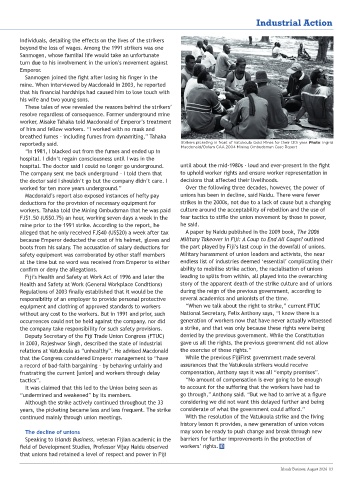
        reportedly said.                                    Strikers picketing in front of Vatukoula Gold Mines for their 13th year. Photo: Ingrid
                                                            Macdonald/Oxfam CAA 2004 Mining Ombudsman Case Report
         “In 1981, I blacked out from the fumes and ended up in
        hospital. I didn’t regain consciousness until I was in the
        hospital. The doctor said I could no longer go underground.   until about the mid-1980s - loud and ever-present in the fight
        The company sent me back underground – I told them that   to uphold worker rights and ensure worker representation in
        the doctor said I shouldn’t go but the company didn’t care. I   decisions that affected their livelihoods.
        worked for ten more years underground.”              Over the following three decades, however, the power of
         Macdonald’s report also exposed instances of hefty pay   unions has been in decline, said Naidu. There were fewer
        deductions for the provision of necessary equipment for   strikes in the 2000s, not due to a lack of cause but a changing
        workers. Tahaka told the Mining Ombudsman that he was paid   culture around the acceptability of rebellion and the use of
        FJ$1.50 (US$0.75) an hour, working seven days a week in the   fear tactics to stifle the union movement by those in power,
        mine prior to the 1991 strike. According to the report, he   he said.
        alleged that he only received FJ$40 (US$20) a week after tax   A paper by Naidu published in the 2009 book, The 2006
        because Emperor deducted the cost of his helmet, gloves and   Military Takeover in Fiji: A Coup to End All Coups? outlined
        boots from his salary. The accusation of salary deductions for   the part played by Fiji’s last coup in the downfall of unions.
        safety equipment was corroborated by other staff members   Military harassment of union leaders and activists, the near
        at the time but no word was received from Emperor to either   endless list of industries deemed ‘essential’ complicating their
        confirm or deny the allegations.                    ability to mobilise strike action, the racialisation of unions
         Fiji’s Health and Safety at Work Act of 1996 and later the   leading to splits from within, all played into the overarching
        Health and Safety at Work (General Workplace Conditions)   story of the apparent death of the strike culture and of unions
        Regulations of 2003 finally established that it would be the   during the reign of the previous government, according to
        responsibility of an employer to provide personal protective   several academics and unionists of the time.
        equipment and clothing of approved standards to workers   “When we talk about the right to strike,” current FTUC
        without any cost to the workers. But in 1991 and prior, such   National Secretary, Felix Anthony says, “I know there is a
        occurrences could not be held against the company, nor did   generation of workers now that have never actually witnessed
        the company take responsibility for such safety provisions.   a strike, and that was only because these rights were being
         Deputy Secretary of the Fiji Trade Union Congress (FTUC)   denied by the previous government. While the Constitution
        in 2003, Rajeshwar Singh, described the state of industrial   gave us all the rights, the previous government did not allow
        relations at Vatukoula as “unhealthy”. He advised Macdonald   the exercise of these rights.”
        that the Congress considered Emperor management to “have   While the previous FijiFirst government made several
        a record of bad-faith bargaining – by behaving unfairly and   assurances that the Vatukoula strikers would receive
        frustrating the current [union] and workers through delay   compensation, Anthony says it was all “empty promises”.
        tactics”.                                            “No amount of compensation is ever going to be enough
         It was claimed that this led to the Union being seen as   to account for the suffering that the workers have had to
        “undermined and weakened” by its members.           go through,” Anthony said. “But we had to arrive at a figure
         Although the strike actively continued throughout the 33   considering we did not want this delayed further and being
        years, the picketing became less and less frequent. The strike   considerate of what the government could afford.”
        continued mainly through union meetings.             With the resolution of the Vatukoula strike and the living
                                                            history lesson it provides, a new generation of union voices
         The decline of unions                              may soon be ready to push change and break through new
         Speaking to Islands Business, veteran Fijian academic in the   barriers for further improvements in the protection of
        field of Development Studies, Professor Vijay Naidu observed   workers’ rights.
        that unions had retained a level of respect and power in Fiji

                                                                                            Islands Business, August 2024  13

