


Page 36 - IB June July 2024
P. 36
Opinion

         WOKBAOT WETEM KALJA: CULTURE AND

             DISASTER MANAGEMENT IN VANUATU


        By Anna Naupa, Vanessa Organo and Elise Huffer

          “Climate displacement of populations is the main
        feature of our future. We have to be ready for it and
        plan for it now.” So said Vanuatu’s Minister for Climate
        Change, Ralph Regenvanu, when he took office in
        2022.
          The reality of any relocation in Vanuatu is that
        it is mostly carried out in the context of kastom
        (community-based culture), as 97% of land in Vanuatu
        is under customary tenure. The state’s role in
        managing disaster-induced displacement is nuanced
        owing to its overlap with customary institutions serving
        a similar function. Cultural systems must therefore be
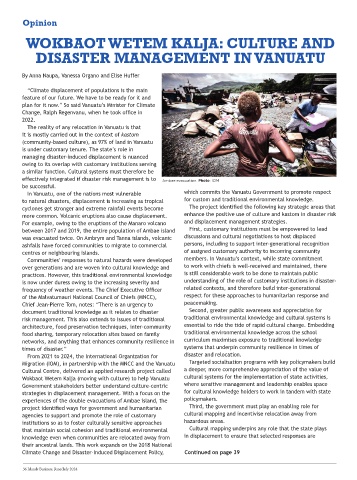
        effectively integrated if disaster risk management is to   Ambae evacuation. Photo: IOM
        be successful.
          In Vanuatu, one of the nations most vulnerable     which commits the Vanuatu Government to promote respect
        to natural disasters, displacement is increasing as tropical   for custom and traditional environmental knowledge.
        cyclones get stronger and extreme rainfall events become   The project identified the following key strategic areas that
        more common. Volcanic eruptions also cause displacement.   enhance the positive use of culture and kastom in disaster risk
        For example, owing to the eruptions of the Manaro volcano   and displacement management strategies.
        between 2017 and 2019, the entire population of Ambae island   First, customary institutions must be empowered to lead
        was evacuated twice. On Ambrym and Tanna islands, volcanic   discussions and cultural negotiations to host displaced
        ashfalls have forced communities to migrate to commercial   persons, including to support inter-generational recognition
        centres or neighbouring islands.                     of assigned customary authority to incoming community
          Communities’ responses to natural hazards were developed   members. In Vanuatu’s context, while state commitment
        over generations and are woven into cultural knowledge and   to work with chiefs is well-received and maintained, there
        practices. However, this traditional environmental knowledge   is still considerable work to be done to maintain public
        is now under duress owing to the increasing severity and   understanding of the role of customary institutions in disaster-
        frequency of weather events. The Chief Executive Officer   related contexts, and therefore build inter-generational
        of the Malvatumauri National Council of Chiefs (MNCC),   respect for these approaches to humanitarian response and
        Chief Jean-Pierre Tom, notes: “There is an urgency to   peacemaking.
        document traditional knowledge as it relates to disaster   Second, greater public awareness and appreciation for
        risk management. This also extends to issues of traditional   traditional environmental knowledge and cultural systems is
        architecture, food preservation techniques, inter-community   essential to ride the tide of rapid cultural change. Embedding
        food sharing, temporary relocation sites based on family   traditional environmental knowledge across the school
        networks, and anything that enhances community resilience in   curriculum maximises exposure to traditional knowledge
        times of disaster.”                                  systems that underpin community resilience in times of
          From 2021 to 2024, the International Organization for   disaster and relocation.
        Migration (IOM), in partnership with the MNCC and the Vanuatu   Targeted socialisation programs with key policymakers build
        Cultural Centre, delivered an applied research project called   a deeper, more comprehensive appreciation of the value of
        Wokbaot Wetem Kalja (moving with culture) to help Vanuatu   cultural systems for the implementation of state activities,
        Government stakeholders better understand culture-centric   where sensitive management and leadership enables space
        strategies in displacement management. With a focus on the   for cultural knowledge holders to work in tandem with state
        experiences of the double evacuations of Ambae island, the   policymakers.
        project identified ways for government and humanitarian   Third, the government must play an enabling role for
        agencies to support and promote the role of customary   cultural mapping and incentivise relocation away from
        institutions so as to foster culturally sensitive approaches   hazardous areas.
        that maintain social cohesion and traditional environmental   Cultural mapping underpins any role that the state plays
        knowledge even when communities are relocated away from   in displacement to ensure that selected responses are
        their ancestral lands. This work expands on the 2018 National
        Climate Change and Disaster-Induced Displacement Policy,   Continued on page 39


        36 Islands Business, June/July 2024

