


Page 12 - IB April 24
P. 12
Cover


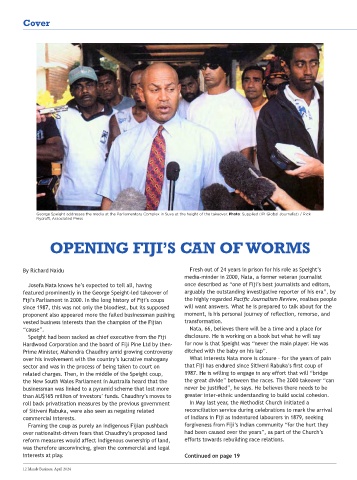
             George Speight addresses the media at the Parliamentary Complex in Suva at the height of the takeover. Photo: Supplied (IPI Global Journalist) / Rick
             Rycroft, Associated Press


                 OPENING FIJI’S CAN OF WORMS


        By Richard Naidu                                       Fresh out of 24 years in prison for his role as Speight’s
                                                             media-minder in 2000, Nata, a former veteran journalist
          Josefa Nata knows he’s expected to tell all, having   once described as “one of Fiji’s best journalists and editors,
        featured prominently in the George Speight-led takeover of   arguably the outstanding investigative reporter of his era”, by
        Fiji’s Parliament in 2000. In the long history of Fiji’s coups   the highly regarded Pacific Journalism Review, realises people
        since 1987, this was not only the bloodiest, but its supposed   will want answers. What he is prepared to talk about for the
        proponent also appeared more the failed businessman pushing   moment, is his personal journey of reflection, remorse, and
        vested business interests than the champion of the Fijian   transformation.
        “cause”.                                               Nata, 66, believes there will be a time and a place for
          Speight had been sacked as chief executive from the Fiji   disclosure. He is working on a book but what he will say
        Hardwood Corporation and the board of Fiji Pine Ltd by then-   for now is that Speight was “never the main player. He was
        Prime Minister, Mahendra Chaudhry amid growing controversy   ditched with the baby on his lap”.
        over his involvement with the country’s lucrative mahogany   What interests Nata more is closure – for the years of pain
        sector and was in the process of being taken to court on   that Fiji has endured since Sitiveni Rabuka’s first coup of
        related charges. Then, in the middle of the Speight coup,   1987. He is willing to engage in any effort that will “bridge
        the New South Wales Parliament in Australia heard that the   the great divide” between the races. The 2000 takeover “can
        businessman was linked to a pyramid scheme that lost more   never be justified”, he says. He believes there needs to be
        than AU$165 million of investors’ funds. Chaudhry’s moves to   greater inter-ethnic understanding to build social cohesion.
        roll back privatisation measures by the previous government   In May last year, the Methodist Church initiated a
        of Sitiveni Rabuka, were also seen as negating related   reconciliation service during celebrations to mark the arrival
        commercial interests.                                of Indians in Fiji as indentured labourers in 1879, seeking
          Framing the coup as purely an indigenous Fijian pushback   forgiveness from Fiji’s Indian community “for the hurt they
        over nationalist-driven fears that Chaudhry’s proposed land   had been caused over the years”, as part of the Church’s
        reform measures would affect indigenous ownership of land,   efforts towards rebuilding race relations.
        was therefore unconvincing, given the commercial and legal
        interests at play.                                   Continued on page 19

        12 Islands Business, April 2024

