


Page 10 - IB April 24
P. 10
History                                                                                                                                                                                                       History


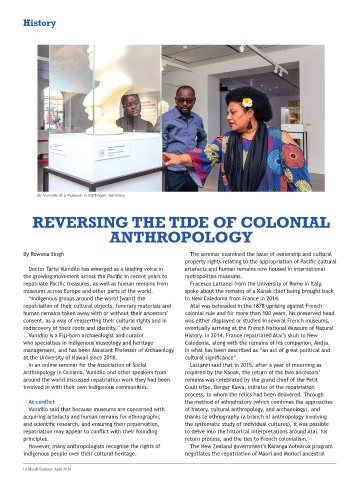
             Dr Vunidilo at a museum in Göttingen, Germany.


            REVERSING THE TIDE OF COLONIAL

                                     ANTHROPOLOGY


         By Rowena Singh                                       The seminar examined the issue of ownership and cultural
                                                             property rights relating to the appropriation of Pacific cultural
          Doctor Tarisi Vunidilo has emerged as a leading voice in   artefacts and human remains now housed in international
         the growing movement across the Pacific in recent years to   metropolitan museums.
         repatriate Pacific treasures, as well as human remains from   Fracesco Lattanzi from the University of Rome in Italy,
         museums across Europe and other parts of the world.  spoke about the remains of a Kanak chief being brought back
          “Indigenous groups around the world [want] the     to New Caledonia from France in 2014.
         repatriation of their cultural objects, funerary materials and   Ataï was beheaded in the 1878 uprising against French
         human remains taken away with or without their ancestors’   colonial rule and for more than 100 years, his preserved head
         consent, as a way of reasserting their cultural rights and in   was either displayed or studied in several French museums,
         rediscovery of their roots and identity,” she said.  eventually arriving at the French National Museum of Natural
          Vunidilo is a Fiji-born archaeologist and curator   History. In 2014, France repatriated Ataï’s skull to New
         who specialises in indigenous museology and heritage   Caledonia, along with the remains of his companion, Andja,
         management, and has been Assistant Professor of Archaeology   in what has been described as “an act of great political and
         at the University of Hawaii since 2018.             cultural significance”.
          In an online seminar for the Association of Social   Lattanzi said that in 2015, after a year of mourning as
         Anthropology in Oceania, Vunidilo and other speakers from   required by the Kanak, the return of the two ancestors’
         around the world discussed repatriation work they had been   remains was celebrated by the grand chief of the Petit
         involved in with their own indigenous communities.   Couli tribe, Berger Kawa, initiator of the repatriation
                                                             process, to whom the relics had been delivered. Through
          At conflict                                        the method of ethnohistory (which combines the approaches
          Vunidilo said that because museums are concerned with   of history, cultural anthropology, and archaeology), and
         acquiring artefacts and human remains for ethnographic   thanks to ethnography (a branch of anthropology involving
         and scientific research, and ensuring their preservation,   the systematic study of individual cultures), it was possible
         repatriation may appear to conflict with their founding   to delve into the historical interpretations around Ataï, his
         principles.                                         return process, and the ties to French colonialism.
          However, many anthropologists recognise the rights of   The New Zealand government’s Karanga Aotearoa program
         indigenous people over their cultural heritage.     negotiates the repatriation of Māori and Moriori ancestral


        10 Islands Business, April 2024

