


Page 32 - IBs November 2022
P. 32
Environment                                                                                                                                                                                        Environment


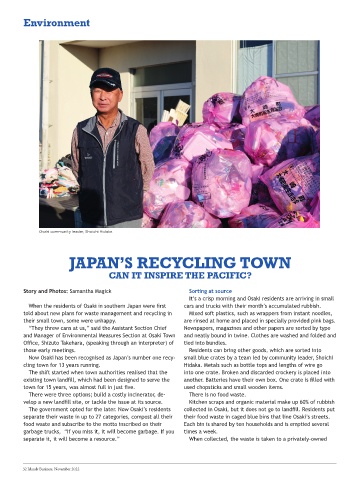
              Osaki community leader, Shoichi Hidaka.


                        JAPAN’S RECYCLING TOWN


                                    CAN IT INSPIRE THE PACIFIC?

         Story and Photos: Samantha Magick                     Sorting at source
                                                               It’s a crisp morning and Osaki residents are arriving in small
          When the residents of Osaki in southern Japan were first   cars and trucks with their month’s accumulated rubbish.
         told about new plans for waste management and recycling in   Mixed soft plastics, such as wrappers from instant noodles,
         their small town, some were unhappy.                are rinsed at home and placed in specially provided pink bags.
          “They threw cans at us,” said the Assistant Section Chief   Newspapers, magazines and other papers are sorted by type
         and Manager of Environmental Measures Section at Osaki Town   and neatly bound in twine. Clothes are washed and folded and
         Office, Shizuto Takehara, (speaking through an interpreter) of   tied into bundles.
         those early meetings.                                 Residents can bring other goods, which are sorted into
          Now Osaki has been recognised as Japan’s number one recy-  small blue crates by a team led by community leader, Shoichi
         cling town for 13 years running.                    Hidaka. Metals such as bottle tops and lengths of wire go
          The shift started when town authorities realised that the   into one crate. Broken and discarded crockery is placed into
         existing town landfill, which had been designed to serve the   another. Batteries have their own box. One crate is filled with
         town for 15 years, was almost full in just five.    used chopsticks and small wooden items.
          There were three options; build a costly incinerator, de-  There is no food waste.
         velop a new landfill site, or tackle the issue at its source.  Kitchen scraps and organic material make up 60% of rubbish
          The government opted for the later. Now Osaki’s residents   collected in Osaki, but it does not go to landfill. Residents put
         separate their waste in up to 27 categories, compost all their   their food waste in caged blue bins that line Osaki’s streets.
         food waste and subscribe to the motto inscribed on their   Each bin is shared by ten households and is emptied several
         garbage trucks,  “If you miss it, it will become garbage. If you   times a week.
         separate it, it will become a resource.”              When collected, the waste is taken to a privately-owned


        32 Islands Business, November 2022

