


Page 33 - Islands Business October 2022
P. 33
Health


                    SAVED FROM THE UNKNOWN

                 STEPPING UP THE FIGHT AGAINST CERVICAL CANCER

         By Samantha Magick                                 Chris Golden, says the network is looking into outreach work
                                                            on cervical cancer, but the lack of data is problematic.
         One in four women with cervical cancer live in what the   “We do lack data. Of the nine countries we are in, only five
        World Health Organisation (WHO) defines as the ‘Western   of them provide cervical cancer data. Four of them either do
        Pacific Region’, a collection of Asia and Pacific Island states   not, or it’s old and hasn’t been counted in many years. So lack
        and territories.                                    of data is probably the biggest problem we have.”
         An estimated 145,700 women were diagnosed with cervi-  He continues: “Cervical cancer is the second most prevalent
        cal cancer in 2020 says WHO. And of those, 74,900 died from   form of cancer affecting women in the Pacific. In Solomon
        what is a largely preventable disease.              Islands and Marshall Islands it’s the largest form of cancer
          It is the second most common cancer in Melanesia and the   actually. Number one is usually breast cancer. So women are
        sixth in Polynesia.                                                            more likely to die of these
         These alarming statis-                                                        two cancers than any other.
        tics prompted delegates                                                        And the level of prevalence
        attending the World Health                                                     in some countries is really
        Organization (WHO) Re-                                                         quite high, which is why
        gional Committee for the                                                       finding ways to attack it is
        Western Pacific this month                                                     going to be important.”
        to endorse a Strategic                                                           He notes the numbers
        Framework for the Com-                                                         don’t always add up.
        prehensive Prevention and                                                        “We do have some cervi-
        Control of Cervical Cancer                                                     cal cancer data from PNG,
        in the region.                                                                 for example, but they don’t
         More than 95% of cervical                                                     match the population…  And
        cancer cases are linked to                                                     this means therefore most
        infection with high-risk hu-                                                   deaths probably do not go
        man papillomavirus (HPV).                                                      on to report it. Or they’re
        Persistent infections can                                                      reported as other cancers
        cause cervical cancer in                                                       because they appear in
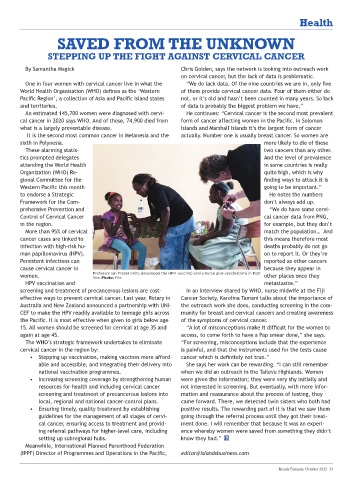
        women.                 Professor Ian Frazer (who developed the HPV vaccine) and a nurse give vaccinations in Port   other places once they
                               Vila. Photo: File
         HPV vaccination and                                                           metastasize.”
        screening and treatment of precancerous lesions are cost-  In an interview shared by WHO, nurse midwife at the Fiji
        effective ways to prevent cervical cancer. Last year, Rotary in   Cancer Society, Karolina Tamani talks about the importance of
        Australia and New Zealand announced a partnership with UNI-  the outreach work she does, conducting screening in the com-
        CEF to make the HPV readily available to teenage girls across   munity for breast and cervical cancers and creating awareness
        the Pacific. It is most effective when given to girls below age   of the symptoms of cervical cancer.
        15. All women should be screened for cervical at age 35 and   “A lot of misconceptions make it difficult for the women to
        again at age 45.                                    access, to come forth to have a Pap smear done,” she says.
         The WHO’s strategic framework undertakes to eliminate   “For screening, misconceptions include that the experience
        cervical cancer in the region by:                   is painful, and that the instruments used for the tests cause
           •  Stepping up vaccination, making vaccines more afford-  cancer which is definitely not true.”
              able and accessible, and integrating their delivery into   She says her work can be rewarding. “I can still remember
              national vaccination programmes.              when we did an outreach in the Tailevu Highlands. Women
           •  Increasing screening coverage by strengthening human   were given the information; they were very shy initially and
              resources for health and including cervical cancer   not interested in screening. But eventually, with more infor-
              screening and treatment of precancerous lesions into   mation and reassurance about the process of testing, they
              local, regional and national cancer-control plans.  came forward. There, we detected twin sisters who both had
           •  Ensuring timely, quality treatment by establishing   positive results. The rewarding part of it is that we saw them
              guidelines for the management of all stages of cervi-  going through the referral process until they got their treat-
              cal cancer, ensuring access to treatment and provid-  ment done. I will remember that because it was an experi-
              ing referral pathways for higher-level care, including   ence whereby women were saved from something they didn’t
              setting up subregional hubs.                  know they had.”
         Meanwhile, International Planned Parenthood Federation
        (IPPF) Director of Programmes and Operations in the Pacific,   editor@islandsbusiness.com


                                                                                            Islands Business, October 2022  33

