


Page 27 - IB May 2025
P. 27
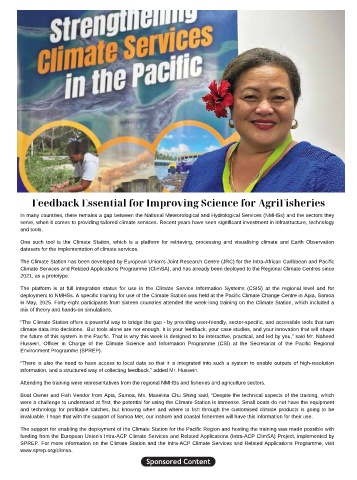
Feedback Essential for Improving Science for AgriFisheries
           Feedback Essential for Improving Science for AgriFisheries
        In many countries, there remains a gap between the National Meteorological and Hydrological Services (NMHSs) and the sectors they
        In many countries, there remains a gap between the National Meteorological and Hydrological Services (NMHSs) and the sectors they
        serve, when it comes to providing tailored climate services. Recent years have seen significant investment in infrastructure, technology
        serve, when it comes to providing tailored climate services. Recent years have seen significant investment in infrastructure, technology
        and tools.
        and tools.
        One  such  tool  is  the  Climate  Station,  which  is  a  platform  for  retrieving,  processing  and  visualising  climate  and  Earth  Observation
        One  such  tool  is  the  Climate  Station,  which  is  a  platform  for  retrieving,  processing  and  visualising  climate  and  Earth  Observation
        datasets for the implementation of climate services.
        datasets for the implementation of climate services.
        The Climate Station has been developed by European Union’s Joint Research Centre (JRC) for the Intra-African Caribbean and Pacific
        The Climate Station has been developed by European Union’s Joint Research Centre (JRC) for the Intra-African Caribbean and Pacific
        Climate Services and Related Applications Programme (ClimSA), and has already been deployed to the Regional Climate Centres since
        Climate Services and Related Applications Programme (ClimSA), and has already been deployed to the Regional Climate Centres since
        2021, as a prototype.
        2021, as a prototype.
        The  platform  is  at  full  integration  status  for  use  in  the  Climate  Service  Information  Systems  (CSIS)  at  the  regional  level  and  for
        The  platform  is  at  full  integration  status  for  use  in  the  Climate  Service  Information  Systems  (CSIS)  at  the  regional  level  and  for
        deployment to NMHSs. A specific training for use of the Climate Station was held at the Pacific Climate Change Centre in Apia, Samoa
        deployment to NMHSs. A specific training for use of the Climate Station was held at the Pacific Climate Change Centre in Apia, Samoa
        in May, 2025. Forty-eight participants from sixteen countries attended the week-long training on the Climate Station, which included a
        in May, 2025. Forty-eight participants from sixteen countries attended the week-long training on the Climate Station, which included a
        mix of theory and hands-on simulations.
        mix of theory and hands-on simulations.
        “The Climate Station offers a powerful way to bridge the gap - by providing user-friendly, sector-specific, and accessible tools that turn
        “The Climate Station offers a powerful way to bridge the gap - by providing user-friendly, sector-specific, and accessible tools that turn
        climate data into decisions.  But tools alone are not enough. It is your feedback, your case studies, and your innovation that will shape
        climate data into decisions.  But tools alone are not enough. It is your feedback, your case studies, and your innovation that will shape
        the future of this system in the Pacific. That is why this week is designed to be interactive, practical, and led by you,” said Mr. Naheed
        the future of this system in the Pacific. That is why this week is designed to be interactive, practical, and led by you,” said Mr. Naheed
        Hussein,  Officer  in  Charge  of  the  Climate  Science  and  Information  Programme  (CSI)  at  the  Secretariat  of  the  Pacific  Regional
        Hussein,  Officer  in  Charge  of  the  Climate  Science  and  Information  Programme  (CSI)  at  the  Secretariat  of  the  Pacific  Regional
        Environment Programme (SPREP).
        Environment Programme (SPREP).
        “There is also the need to have access to local data so that it is integrated into such a system to enable outputs of high-resolution
        “There is also the need to have access to local data so that it is integrated into such a system to enable outputs of high-resolution
        information, and a structured way of collecting feedback,” added Mr. Hussein.
        information, and a structured way of collecting feedback,” added Mr. Hussein.
        Attending the training were representatives from the regional NMHSs and fisheries and agriculture sectors.
        Attending the training were representatives from the regional NMHSs and fisheries and agriculture sectors.
        Boat Owner and Fish Vendor from Apia, Samoa, Ms. Maselina Chu Shing said, “Despite the technical aspects of the training, which
        Boat Owner and Fish Vendor from Apia, Samoa, Ms. Maselina Chu Shing said, “Despite the technical aspects of the training, which
        were a challenge to understand at first, the potential for using the Climate Station is immense. Small boats do not have the equipment
        were a challenge to understand at first, the potential for using the Climate Station is immense. Small boats do not have the equipment
        and  technology  for  profitable  catches,  but  knowing  when  and  where  to  fish  through  the  customised  climate  products  is  going  to  be
        and  technology  for  profitable  catches,  but  knowing  when  and  where  to  fish  through  the  customised  climate  products  is  going  to  be
        invaluable. I hope that with the support of Samoa Met, our inshore and coastal fishermen will have this information for their use.
        invaluable. I hope that with the support of Samoa Met, our inshore and coastal fishermen will have this information for their use.
                     Feedback Essential for Improving Science for AgriFisheries
        The support for enabling the deployment of the Climate Station for the Pacific Region and hosting the training was made possible with
        The support for enabling the deployment of the Climate Station for the Pacific Region and hosting the training was made possible with
                 In many countries, there remains a gap between the National Meteorological and Hydrological Services (NMHSs) and the
        funding from the European Union’s Intra-ACP Climate Services and Related Applications (Intra-ACP ClimSA) Project, implemented by
        funding from the European Union’s Intra-ACP Climate Services and Related Applications (Intra-ACP ClimSA) Project, implemented by sectors they
                 serve, when it comes to providing tailored climate services. Recent years have seen significant investment in infrastructure, technology
        SPREP. For more information on the Climate Station and the Intra-ACP Climate Services and Related Applications Programme, visit
        SPREP. For more information on the Climate Station and the Intra-ACP Climate Services and Related Applications Programme, visit
        www.sprep.org/climsa.
                 and tools
        www.sprep.org/climsa
                                                 Sponsored Content
                                                 Sponsored Content
                 One  such  tool  is  the  Climate  Station,  which  is  a  platform  for  retrieving,  processing  and  visualising  climate  and  Earth  Observation
                 datasets for the implementation of climate services.                         Islands Business May 2025  27
                 The Climate Station has been developed by European Union’s Joint Research Centre (JRC) for the Intra-African Caribbean and Pacific
                 Climate Services and Related Applications Programme (ClimSA), and has already been deployed to the Regional Climate Centres since
                 2021, as a prototype.
                 The  platform  is  at  full  integration  status  for  use  in  the  Climate  Service  Information  Systems  (CSIS)  at  the  regional  level  and  for
                 deployment to NMHSs. A specific training for use of the Climate Station was held at the Pacific Climate Change Centre in Apia, Samoa
                 in May, 2025. Forty-eight participants from sixteen countries attended the week-long training on the Climate Station, which included a
                 mix of theory and hands-on simulations.
                 “The Climate Station offers a powerful way to bridge the gap - by providing user-friendly, sector-specific, and accessible tools that turn
                 climate data into decisions.  But tools alone are not enough. It is your feedback, your case studies, and your innovation that will shape
                 the future of this system in the Pacific. That is why this week is designed to be interactive, practical, and led by you,” said Mr. Naheed
                 Hussein,  Officer  in  Charge  of  the  Climate  Science  and  Information  Programme  (CSI)  at  the  Secretariat  of  the  Pacific  Regional
                 Environment Programme (SPREP).
                 “There is also the need to have access to local data so that it is integrated into such a system to enable outputs of high-resolution
                 information, and a structured way of collecting feedback,” added Mr. Hussein.
                 Attending the training were representatives from the regional NMHSs and fisheries and agriculture sectors.
                 Boat Owner and Fish Vendor from Apia, Samoa, Ms. Maselina Chu Shing said, “Despite the technical aspects of the training, which
                 were a challenge to understand at first, the potential for using the Climate Station is immense. Small boats do not have the equipment
                 and  technology for  profitable  catches,  but  knowing  when  and  where  to  fish  through  the  customised  climate  products  is  going  to  be
                 invaluable. I hope that with the support of Samoa Met, our inshore and coastal fishermen will have this information for their use.
                 The support for enabling the deployment of the Climate Station for the Pacific Region and hosting the training was made possible with
                 funding from the European Union’s Intra-ACP Climate Services and Related Applications (Intra-ACP ClimSA) Project, implemented by
                 SPREP. For more information on the Climate Station and the Intra-ACP Climate Services and Related Applications Programme, visit
                 www.sprep.org/climsa

