


Page 29 - IB February 2025
P. 29
Garment Industry


                         FIJI'S GARMENT INDUSTRY AT

                               (ANOTHER) CROSSROADS


         Look at the label on your                                                     climate, and economic
        clothing, and chances are                                                      uncertainty.
        it will tell you it is made in                                                   “Fiji needs investment,
        China, India, Bangladesh,                                                      but investors need a
        or Vietnam. If it is Pacific                                                   government that treats
        wear, the tag may read Fiji                                                    them with respect and
        or one of her neighbours.                                                      fairness while ensuring
         Fiji once had a thriving                                                      a stable and predictable
        garment industry, with                                                         business environment,” she
        more than 20,000                                                               said.
        employees in 2000.                                                               Some manufacturers
         It is now less than a                                                         are also concerned about
        quarter of that, with                                                          proposed changes to Fiji’s
        Textile, Clothing, and                                                         labour laws, and the short
        Footwear Council (TCF)                                                         time given for review and
        President Inbamalar                                                            consultation on those laws.
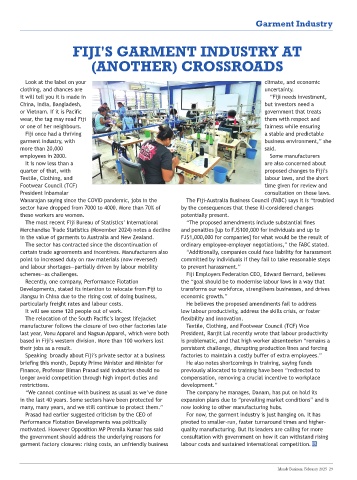
        Wanarajan saying since the COVID pandemic, jobs in the   The Fiji-Australia Business Council (FABC) says it is “troubled
        sector have dropped from 7000 to 4000. More than 70% of   by the consequences that these ill-considered changes
        these workers are women.                            potentially present.
         The most recent Fiji Bureau of Statistics’ International   “The proposed amendments include substantial fines
        Merchandise Trade Statistics (November 2024) notes a decline   and penalties [up to FJ$100,000 for individuals and up to
        in the value of garments to Australia and New Zealand.    FJ$1,000,000 for companies] for what would be the result of
         The sector has contracted since the discontinuation of   ordinary employee-employer negotiations,” the FABC stated.
        certain trade agreements and incentives. Manufacturers also   “Additionally, companies could face liability for harassment
        point to increased duty on raw materials (now reversed)  committed by individuals if they fail to take reasonable steps
        and labour shortages—partially driven by labour mobility   to prevent harassment.”
        schemes—as challenges.                                Fiji Employers Federation CEO, Edward Bernard, believes
         Recently, one company, Performance Flotation       the “goal should be to modernise labour laws in a way that
        Developments, stated its intention to relocate from Fiji to   transforms our workforce, strengthens businesses, and drives
        Jiangsu in China due to the rising cost of doing business,   economic growth.”
        particularly freight rates and labour costs.          He believes the proposed amendments fail to address
         It will see some 120 people out of work.           low labour productivity, address the skills crisis, or foster
         The relocation of the South Pacific’s largest lifejacket   flexibility and innovation.
        manufacturer follows the closure of two other factories late   Textile, Clothing, and Footwear Council (TCF) Vice
        last year, Vonu Apparel and Nagsun Apparel, which were both   President, Ranjit Lal recently wrote that labour productivity
        based in Fiji’s western division. More than 100 workers lost   is problematic, and that high worker absenteeism “remains a
        their jobs as a result.                             persistent challenge, disrupting production lines and forcing
         Speaking  broadly about Fiji’s private sector at a business   factories to maintain a costly buffer of extra employees.”
        briefing this month, Deputy Prime Minister and Minister for   He also notes shortcomings in training, saying funds
        Finance, Professor Biman Prasad said industries should no   previously allocated to training have been “redirected to
        longer avoid competition through high import duties and   compensation, removing a crucial incentive to workplace
        restrictions.                                       development.”
         “We cannot continue with business as usual as we’ve done   The company he manages, Danam, has put on hold its
        in the last 40 years. Some sectors have been protected for   expansion plans due to “prevailing market conditions” and is
        many, many years, and we still continue to protect them.”  now looking to other manufacturing hubs.
         Prasad had earlier suggested criticism by the CEO of   For now, the garment industry is just hanging on. It has
        Performance Flotation Developments was politically   pivoted to smaller-run, faster turnaround times and higher-
        motivated. However Opposition MP Premila Kumar has said   quality manufacturing. But its leaders are calling for more
        the government should address the underlying reasons for   consultation with government on how it can withstand rising
        garment factory closures: rising costs, an unfriendly business   labour costs and sustained international competition.


                                                                                           Islands Business, February 2025  29

