


Page 27 - IB December 2024
P. 27
Climate Change                                                                        Climate Change


        villagers.’’                                          The neighbouring village, Vunisinu, observed the project
         Dredging the depths of their fonts of knowledge, the older   and put in place similar measures to protect their homes.
        villagers remember the lessons taught by their grandparents   “We had become so focused on Western models of
        and great-grandparents.                             development and climate change mitigation that it was not
         For generations, the people of Nalase have dwelt in the   possible for us to see that our solutions existed within the
        delta where the waters of the sea meet the waters of the   community,’’ Rasiga said.
        Rewa River, with its source deep in the mountains of Viti Levu.   “It’s been a really steep learning curve for the young people
        In this ancient place, water has been blessing, curse and a   but they have an appreciation for local knowledge now.
        reality for millennia.                              And they see why this method is called Nana (Mother). Our
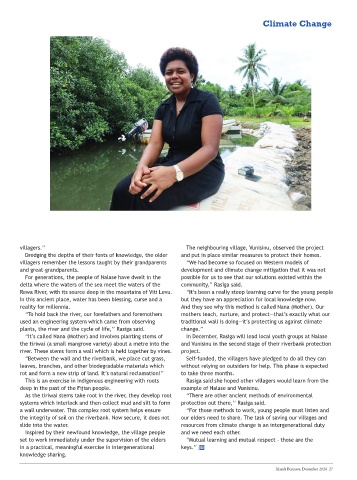
         “To hold back the river, our forefathers and foremothers   mothers teach, nurture, and protect—that’s exactly what our
        used an engineering system which came from observing   traditional wall is doing—it’s protecting us against climate
        plants, the river and the cycle of life,’’ Rasiga said.  change.’’
         “It’s called Nana (Mother) and involves planting stems of   In December, Rasiga will lead local youth groups at Nalase
        the tiriwai (a small mangrove variety) about a metre into the   and Vunisinu in the second stage of their riverbank protection
        river. These stems form a wall which is held together by vines.  project.
         “Between the wall and the riverbank, we place cut grass,   Self-funded, the villagers have pledged to do all they can
        leaves, branches, and other biodegradable materials which   without relying on outsiders for help. This phase is expected
        rot and form a new strip of land. It’s natural reclamation!’’  to take three months.
         This is an exercise in indigenous engineering with roots   Rasiga said she hoped other villagers would learn from the
        deep in the past of the Fijian people.              example of Nalase and Vunisinu.
         As the tiriwai stems take root in the river, they develop root   “There are other ancient methods of environmental
        systems which interlock and then collect mud and silt to form   protection out there,’’ Rasiga said.
        a wall underwater. This complex root system helps ensure   “For those methods to work, young people must listen and
        the integrity of soil on the riverbank. Now secure, it does not   our elders need to share. The task of saving our villages and
        slide into the water.                               resources from climate change is an intergenerational duty
         Inspired by their newfound knowledge, the village people   and we need each other.
        set to work immediately under the supervision of the elders   “Mutual learning and mutual respect – those are the
        in a practical, meaningful exercise in intergenerational   keys.’’
        knowledge sharing.

                                                                                           Islands Business, December 2024  27

