


Page 45 - IB November 2024
P. 45
Music                                                                                              Music


         About Naratana Manu
         “Naratana Manu was written in the Are-Are language which
        is from the Malaita province, and it literally means a bird's
        cry,” says Rohoimae. “And it was a sort of expression that I
        promoted, which relates to something that connects me and
        dad, which is about a bird that’s there when fishing in the
        open sea.”
         Naratana Manu also has a powerful message of resilience
        and addresses the challenges of surrounding yourself with the
        wrong friends or walking alongside someone who perceives
        you in a completely different light.
         Alongside his exceptional guitar playing and singing,
        Rohoimae is skilled in traditional Solomon Islands instruments,
        which play a prominent role in his award-winning track. His
        mastery of these instruments enriches his music, blending
        contemporary sounds with cultural heritage.
         “In the Solomon Islands, we have many types of traditional
        instruments, but in that particular song (Naratana Manu), I
        use three types—one is called Opo, the other one is called
        Awa—these two are flutes. And the other one is called Tara,
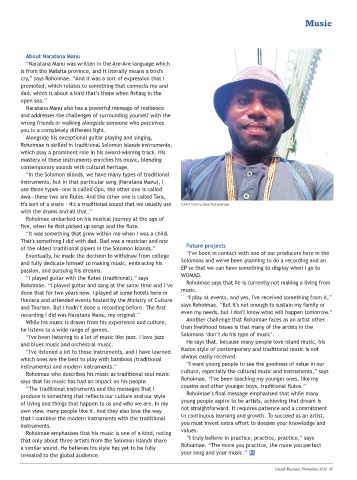
        it's sort of a snare - it's a traditional sound that we usually use   Chris Kamu’ana Rohoimae
        with the drums and all that.”
         Rohoimae embarked on his musical journey at the age of
        five, when he first picked up songs and the flute.
         “It was something that grew within me when I was a child.
        That's something I did with dad. Dad was a musician and one
        of the oldest traditional pipers in the Solomon Islands.”  Future projects
         Eventually, he made the decision to withdraw from college   “I've been in contact with one of our producers here in the
        and fully dedicate himself to making music, embracing his   Solomons and we've been planning to do a recording and an
        passion, and pursuing his dreams.                   EP so that we can have something to display when I go to
         “I played guitar with the flutes (traditional),” says   WOMAD.
        Rohoimae. “I played guitar and sang at the same time and I’ve   Rohoimae says that he is currently not making a living from
        done that for two years now. I played at some hotels here in   music.
        Honiara and attended events hosted by the Ministry of Culture   “I play at events, and yes, I've received something from it,”
        and Tourism. But I hadn’t done a recording before. The first   says Rohoimae. “But it's not enough to sustain my family or
        recording I did was Naratana Manu, my original.”    even my needs, but I don't know what will happen tomorrow.”
         While his music is drawn from his experience and culture,   Another challenge that Rohoimae faces as an artist other
        he listens to a wide range of genres.               than livelihood issues is that many of the artists in the
         “I've been listening to a lot of music like jazz. I love jazz   Solomons ‘don’t do his type of music’.
        and blues music and orchestral music.                 He says that, because many people love island music, his
         “I've listened a lot to those instruments, and I have learned   fusion style of contemporary and traditional music is not
        which ones are the best to play with bamboos (traditional   always easily received.
        instruments) and modern instruments.”                 “I want young people to see the goodness of value in our
         Rohoimae who describes his music as traditional soul music   culture, especially the cultural music and instruments,” says
        says that his music has had an impact on his people.  Rohoimae. “I've been teaching my younger ones, like my
         “The traditional instruments and the messages that I   cousins and other younger boys, traditional flutes.”
        produce is something that reflects our culture and our style   Rohoimae’s final message emphasised that while many
        of living and things that happen to us and who we are. In my   young people aspire to be artists, achieving that dream is
        own view, many people like it. And they also love the way   not straightforward. It requires patience and a commitment
        that I combine the modern instruments with the traditional   to continuous learning and growth. To succeed as an artist,
        instruments.                                        you must invest extra effort to deepen your knowledge and
         Rohoimae emphasises that his music is one of a kind, noting   values.
        that only about three artists from the Solomon Islands share   “I truly believe in practice, practice, practice,” says
        a similar sound. He believes his style has yet to be fully   Rohoimae. “The more you practice, the more you perfect
        revealed to the global audience.                    your song and your music.”

                                                                                           Islands Business, November 2024  45

