


Page 41 - IB November 2024
P. 41
Reef Rehabilitation                                                               Reef Rehabilitation


                                                            coral reefs.
        By Gordon Feller                                      Indonesian reefs are diverse in physical structure - ranging
                                                            from fringing reefs to atolls to barrier reefs. They are also
         It is the oceans challenge of our time: to protect   diverse in biological community structure, supporting an
        and sustainably manage unique coral ecosystems.     unparalleled array of coral species reef fish, mollusks,
        Several innovative strategies are being used in     crustaceans, and associated fauna and flora. Despite the
        Indonesia to help coral reefs recover and repair,   biological diversity and wealth of Indonesian coral reef
        which could potentially be applied throughout the   ecosystems, they are at increasing risk from a combination
        Pacific Islands.                                    of factors. Paramount is climate change, and ever-escalating
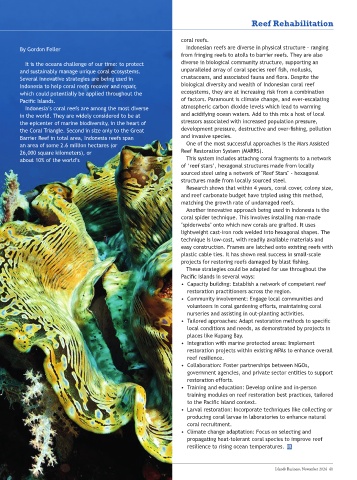
         Indonesia’s coral reefs are among the most diverse   atmospheric carbon dioxide levels which lead to warming
        in the world. They are widely considered to be at   and acidifying ocean waters. Add to this mix a host of local
        the epicenter of marine biodiversity, in the heart of   stressors associated with increased population pressure,
        the Coral Triangle. Second in size only to the Great   development pressure, destructive and over-fishing, pollution
        Barrier Reef in total area, Indonesia reefs span    and invasive species.
        an area of some 2.6 million hectares (or              One of the most successful approaches is the Mars Assisted
        26,000 square kilometers), or                       Reef Restoration System (MARRS).
        about 10% of the world’s                              This system includes attachng coral fragments to a network
                                                            of ‘reef stars’, hexagonal structures made from locally
                                                            sourced steel using a network of "Reef Stars" - hexagonal
                                                            structures made from locally sourced steel.
                                                              Research shows that within 4 years, coral cover, colony size,
                                                            and reef carbonate budget have tripled using this method,
                                                            matching the growth rate of undamaged reefs.
                                                              Another innovative approach being used in Indonesia is the
                                                            coral spider technique. This Involves installing man-made
                                                            "spiderwebs" onto which new corals are grafted. It uses
                                                            lightweight cast-iron rods welded into hexagonal shapes. The
                                                            technique is low-cost, with readily available materials and
                                                            easy construction. Frames are latched onto existing reefs with
                                                            plastic cable ties. It has shown real success in small-scale
                                                            projects for restoring reefs damaged by blast fishing.
                                                              These strategies could be adapted for use throughout the
                                                            Pacific Islands in several ways:
                                                            •  Capacity building: Establish a network of competent reef
                                                              restoration practitioners across the region.
                                                            •  Community involvement: Engage local communities and
                                                              volunteers in coral gardening efforts, maintaining coral
                                                              nurseries and assisting in out-planting activities.
                                                            •  Tailored approaches: Adapt restoration methods to specific
                                                              local conditions and needs, as demonstrated by projects in
                                                              places like Kupang Bay.
                                                            •  Integration with marine protected areas: Implement
                                                              restoration projects within existing MPAs to enhance overall
                                                              reef resilience.
                                                            •  Collaboration: Foster partnerships between NGOs,
                                                              government agencies, and private sector entities to support
                                                              restoration efforts.
                                                            •  Training and education: Develop online and in-person
                                                              training modules on reef restoration best practices, tailored
                                                              to the Pacific Island context.
                                                            •  Larval restoration: Incorporate techniques like collecting or
                                                              producing coral larvae in laboratories to enhance natural
                                                              coral recruitment.
                                                            •  Climate change adaptation: Focus on selecting and
                                                              propagating heat-tolerant coral species to improve reef
                                                              resilience to rising ocean temperatures.


                                                                                           Islands Business, November 2024  41

