


Page 17 - IB June July 2024
P. 17
Cover                                                                                               Cover


        By Samantha Magick

         At the halfway of the recent Festival for Pacific Arts and
        Culture (FestPAC), its operations director Makanani Sali
        described it as a “beautiful, chaotic mess” in an interview
        with local media. And that is how it often felt as a delegate,
        as there were so many important activities happening
        simultaneously across Oahu. Many of those have been
        broadcast and shared already, but there were a few themes
        that continue to provoke thought and reflection.
         The meeting of culture and commerce
         The venues at which artists and thinkers gathered in
        Hawaii, spoke to the many discussions being held formally
        and informally throughout the festival. The main site, the
        Honolulu Convention Centre, is a sprawling glass and steel
        structure. In the central gathering area, visitors crossed a
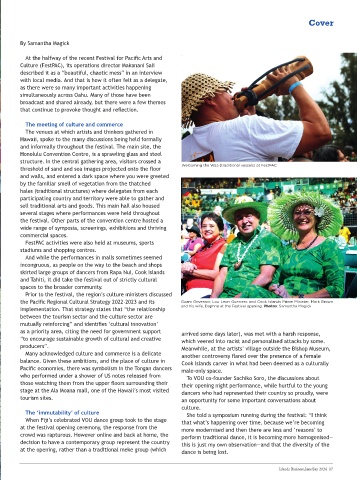
                                                            Welcoming the Waa (traditional vessels) at FestPAC
        threshold of sand and sea images projected onto the floor
        and walls, and entered a dark space where you were greeted
        by the familiar smell of vegetation from the thatched
        hales (traditional structures) where delegates from each
        participating country and territory were able to gather and
        sell traditional arts and goods. This main hall also housed
        several stages where performances were held throughout
        the festival. Other parts of the convention centre hosted a
        wide range of symposia, screenings, exhibitions and thriving
        commercial spaces.
         FestPAC activities were also held at museums, sports
        stadiums and shopping centres.
         And while the performances in malls sometimes seemed
        incongruous, as people on the way to the beach and shops
        skirted large groups of dancers from Rapa Nui, Cook Islands
        and Tahiti, it did take the festival out of strictly cultural
        spaces to the broader community.
         Prior to the festival, the region’s culture ministers discussed
        the Pacific Regional Cultural Strategy 2022-2023 and its   Guam Governor, Lou Leon Guerrero and Cook Islands Prime Minister, Mark Brown
        implementation. That strategy states that “the relationship   and his wife, Daphne at the Festival opening. Photos: Samantha Magick
        between the tourism sector and the culture sector are
        mutually reinforcing” and identifies ‘cultural innovation’
        as a priority area, citing the need for government support   arrived some days later), was met with a harsh response,
        “to encourage sustainable growth of cultural and creative   which veered into racist and personalised attacks by some.
        producers”.                                         Meanwhile, at the artists’ village outside the Bishop Museum,
         Many acknowledged culture and commerce is a delicate   another controversy flared over the presence of a female
        balance. Given these ambitions, and the place of culture in   Cook Islands carver in what had been deemed as a culturally
        Pacific economies, there was symbolism in the Tongan dancers   male-only space.
        who performed under a shower of US notes released from   To VOU co-founder Sachiko Soro, the discussions about
        those watching them from the upper floors surrounding their   their opening night performance, while hurtful to the young
        stage at the Ala Moana mall, one of the Hawaii’s most visited   dancers who had represented their country so proudly, were
        tourism sites.                                      an opportunity for some important conversations about
                                                            culture.
         The ‘immutability’ of culture                        She told a symposium running during the festival: “I think
         When Fiji’s celebrated VOU dance group took to the stage   that what’s happening over time, because we’re becoming
        at the festival opening ceremony, the response from the   more modernised and then there are less and ‘reasons’ to
        crowd was rapturous. However online and back at home, the   perform traditional dance, it is becoming more homogenised—
        decision to have a contemporary group represent the country   this is just my own observation—and that the diversity of the
        at the opening, rather than a traditional meke group (which   dance is being lost.


                                                                                            Islands Business,June/Juy 2024  17

