


Page 26 - IB April 24
P. 26
Tourism


                           PROTECTING TOURISM’S
                                BIGGEST DRAWCARD


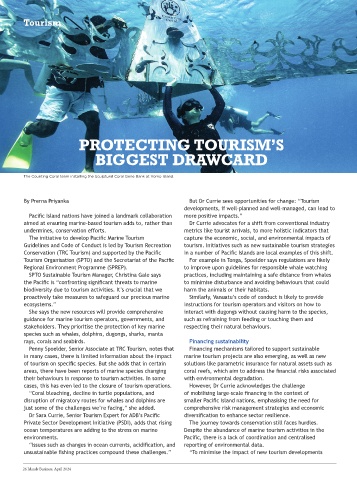
         The Counting Coral team installing the Sculptural Coral Gene Bank at Vomo Island.


         By Prerna Priyanka                                    But Dr Currie sees opportunities for change: “Tourism
                                                             developments, if well-planned and well-managed, can lead to
          Pacific Island nations have joined a landmark collaboration   more positive impacts.”
         aimed at ensuring marine-based tourism adds to, rather than   Dr Currie advocates for a shift from conventional industry
         undermines, conservation efforts.                   metrics like tourist arrivals, to more holistic indicators that
          The initiative to develop Pacific Marine Tourism   capture the economic, social, and environmental impacts of
         Guidelines and Code of Conduct is led by Tourism Recreation   tourism. Initiatives such as new sustainable tourism strategies
         Conservation (TRC Tourism) and supported by the Pacific   in a number of Pacific Islands are local examples of this shift.
         Tourism Organisation (SPTO) and the Secretariat of the Pacific   For example in Tonga, Spoelder says regulations are likely
         Regional Environment Programme (SPREP).             to improve upon guidelines for responsible whale watching
          SPTO Sustainable Tourism Manager, Christina Gale says   practices, including maintaining a safe distance from whales
         the Pacific is “confronting significant threats to marine   to minimise disturbance and avoiding behaviours that could
         biodiversity due to tourism activities. It’s crucial that we   harm the animals or their habitats.
         proactively take measures to safeguard our precious marine   Similarly, Vanuatu’s code of conduct is likely to provide
         ecosystems.”                                        instructions for tourism operators and visitors on how to
          She says the new resources will provide comprehensive   interact with dugongs without causing harm to the species,
         guidance for marine tourism operators, governments, and   such as refraining from feeding or touching them and
         stakeholders. They prioritise the protection of key marine   respecting their natural behaviours.
         species such as whales, dolphins, dugongs, sharks, manta
         rays, corals and seabirds.                            Financing sustainability
          Penny Spoelder, Senior Associate at TRC Tourism, notes that   Financing mechanisms tailored to support sustainable
         in many cases, there is limited information about the impact   marine tourism projects are also emerging, as well as new
         of tourism on specific species. But she adds that in certain   solutions like parametric insurance for natural assets such as
         areas, there have been reports of marine species changing   coral reefs, which aim to address the financial risks associated
         their behaviours in response to tourism activities. In some   with environmental degradation.
         cases, this has even led to the closure of tourism operations.   However, Dr Currie acknowledges the challenge
          “Coral bleaching, decline in turtle populations, and   of mobilising large-scale financing in the context of
         disruption of migratory routes for whales and dolphins are   smaller Pacific Island nations, emphasising the need for
         just some of the challenges we’re facing,” she added.  comprehensive risk management strategies and economic
          Dr Sara Currie, Senior Tourism Expert for ADB’s Pacific   diversification to enhance sector resilience.
         Private Sector Development Initiative (PSDI), adds that rising   The journey towards conservation still faces hurdles.
         ocean temperatures are adding to the stress on marine   Despite the abundance of marine tourism activities in the
         environments.                                       Pacific, there is a lack of coordination and centralised
          “Issues such as changes in ocean currents, acidification, and   reporting of environmental data.
         unsustainable fishing practices compound these challenges.”  “To minimise the impact of new tourism developments


        26 Islands Business, April 2024

