


Page 12 - Islands Business March 2024
P. 12
Nuclear Legacy


                                really frightened. My father tried   cultural performances. Students studying overseas zoomed in,
                                to pick me up, to hold me, but   including members of the Marshall Islands Students Association
                                I wouldn’t let him. We were   at the University of the South Pacific (USP) in Fiji, and the
                                evacuated by the US.         Marshallese Educational Initiative (MEI) in Arkansas, USA.
                                 “Until now, I long for my     The Marshallese students were joined by a delegation from
                                homeland,” she said. “I always   Japanese universities in Hiroshima and Tokyo. They reflected
                                think about my homeland and I   on the fate of Japanese sailors affected by radioactive fallout
                                wish one day—with the help of   from the Bravo test, as dozens of fishing boats near Bikini
                                our President—that I may set foot   and Enewetak atolls were showered with radiation from the
                                again on my homeland.”       15-megaton blast on 1 March 1954. They also discussed the
                                 It’s a heavy burden for     Japanese government’s current program to dump treated
                                President Heine. Since taking   nuclear wastewater from the stricken nuclear reactor at
                                office in January, she has visited   Fukushima into the Pacific Ocean.
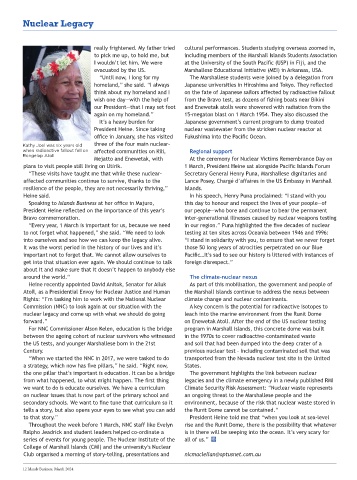
        Kathy Joel was six years old   three of the four main nuclear-
        when radioactive fallout fell on   affected communities on Kili,   Regional support
        Rongelap Atoll
                                Mejatto and Enewetak, with     At the ceremony for Nuclear Victims Remembrance Day on
         plans to visit people still living on Utirik.       1 March, President Heine sat alongside Pacific Islands Forum
          “These visits have taught me that while these nuclear-  Secretary General Henry Puna, Marshallese dignitaries and
         affected communities continue to survive, thanks to the   Lance Posey, Chargé d’affaires in the US Embassy in Marshall
         resilience of the people, they are not necessarily thriving,”   Islands.
         Heine said.                                           In his speech, Henry Puna proclaimed: “I stand with you
          Speaking to Islands Business at her office in Majuro,   this day to honour and respect the lives of your people—of
         President Heine reflected on the importance of this year’s   our people—who bore and continue to bear the permanent
         Bravo commemoration.                                inter-generational illnesses caused by nuclear weapons testing
          “Every year, 1 March is important for us, because we need   in our region.” Puna highlighted the five decades of nuclear
         to not forget what happened,” she said. “We need to look   testing at ten sites across Oceania between 1946 and 1996:
         into ourselves and see how we can keep the legacy alive.   “I stand in solidarity with you, to ensure that we never forget
         It was the worst period in the history of our lives and it’s   those 50 long years of atrocities perpetrated on our Blue
         important not to forget that. We cannot allow ourselves to   Pacific…It’s sad to see our history is littered with instances of
         get into that situation ever again. We should continue to talk   foreign disrespect.”
         about it and make sure that it doesn’t happen to anybody else
         around the world.”                                    The climate-nuclear nexus
          Heine recently appointed David Anitok, Senator for Ailuk   As part of this mobilisation, the government and people of
         Atoll, as a Presidential Envoy for Nuclear Justice and Human   the Marshall Islands continue to address the nexus between
         Rights: “I’m tasking him to work with the National Nuclear   climate change and nuclear contaminants.
         Commission (NNC) to look again at our situation with the   A key concern is the potential for radioactive isotopes to
         nuclear legacy and come up with what we should do going   leach into the marine environment from the Runit Dome
         forward.”                                           on Enewetak Atoll. After the end of the US nuclear testing
          For NNC Commissioner Alson Kelen, education is the bridge   program in Marshall Islands, this concrete dome was built
         between the ageing cohort of nuclear survivors who witnessed   in the 1970s to cover radioactive-contaminated waste
         the US tests, and younger Marshallese born in the 21st   and soil that had been dumped into the deep crater of a
         Century.                                            previous nuclear test – including contaminated soil that was
          “When we started the NNC in 2017, we were tasked to do   transported from the Nevada nuclear test site in the United
         a strategy, which now has five pillars,” he said. “Right now,   States.
         the one pillar that’s important is education. It can be a bridge   The government highlights the link between nuclear
         from what happened, to what might happen. The first thing   legacies and the climate emergency in a newly published RMI
         we want to do is educate ourselves. We have a curriculum   Climate Security Risk Assessment: “Nuclear waste represents
         on nuclear issues that is now part of the primary school and   an ongoing threat to the Marshallese people and the
         secondary schools. We want to fine tune that curriculum so it   environment, because of the risk that nuclear waste stored in
         tells a story, but also opens your eyes to see what you can add   the Runit Dome cannot be contained.”
         to that story.”                                       President Heine told me that “when you look at sea-level
          Throughout the week before 1 March, NNC staff like Evelyn   rise and the Runit Dome, there is the possibility that whatever
         Ralpho Jeadrick and student leaders helped co-ordinate a   is in there will be seeping into the ocean. It’s very scary for
         series of events for young people. The Nuclear Institute of the   all of us.”
         College of Marshall Islands (CMI) and the university’s Nuclear
         Club organised a morning of story-telling, presentations and   nicmaclellan@optusnet.com.au

        12 Islands Business, March 2024

