


Page 22 - Islands Business May-June 2022
P. 22
Oceans


                    BLEACHING DISTRESS SIGNAL


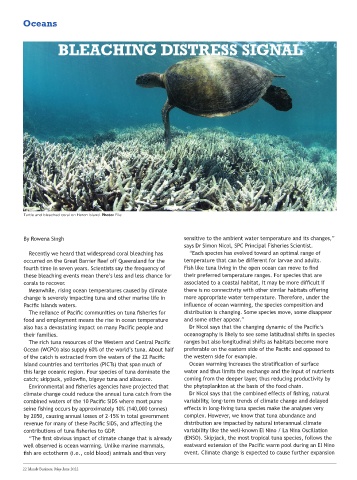
         Turtle and bleached coral on Heron Island. Photo: File


         By Rowena Singh                                     sensitive to the ambient water temperature and its changes,”
                                                             says Dr Simon Nicol, SPC Principal Fisheries Scientist.
          Recently we heard that widespread coral bleaching has   “Each species has evolved toward an optimal range of
         occurred on the Great Barrier Reef off Queensland for the   temperature that can be different for larvae and adults.
         fourth time in seven years. Scientists say the frequency of   Fish like tuna living in the open ocean can move to find
         these bleaching events mean there’s less and less chance for   their preferred temperature ranges. For species that are
         corals to recover.                                  associated to a coastal habitat, it may be more difficult if
          Meanwhile, rising ocean temperatures caused by climate   there is no connectivity with other similar habitats offering
         change is severely impacting tuna and other marine life in   more appropriate water temperature. Therefore, under the
         Pacific Islands waters.                             influence of ocean warming, the species composition and
          The reliance of Pacific communities on tuna fisheries for   distribution is changing. Some species move, some disappear
         food and employment means the rise in ocean temperature   and some other appear.”
         also has a devastating impact on many Pacific people and   Dr Nicol says that the changing dynamic of the Pacific’s
         their families.                                     oceanography is likely to see some latitudinal shifts in species
          The rich tuna resources of the Western and Central Pacific   ranges but also longitudinal shifts as habitats become more
         Ocean (WCPO) also supply 60% of the world’s tuna. About half   preferable on the eastern side of the Pacific and opposed to
         of the catch is extracted from the waters of the 22 Pacific   the western side for example.
         Island countries and territories (PICTs) that span much of   Ocean warming increases the stratification of surface
         this large oceanic region. Four species of tuna dominate the   water and thus limits the exchange and the input of nutrients
         catch; skipjack, yellowfin, bigeye tuna and albacore.   coming from the deeper layer, thus reducing productivity by
          Environmental and fisheries agencies have projected that   the phytoplankton at the basis of the food chain.
         climate change could reduce the annual tuna catch from the   Dr Nicol says that the combined effects of fishing, natural
         combined waters of the 10 Pacific SIDS where most purse   variability, long-term trends of climate change and delayed
         seine fishing occurs by approximately 10% (140,000 tonnes)   effects in long-living tuna species make the analyses very
         by 2050, causing annual losses of 2-15% in total government   complex. However, we know that tuna abundance and
         revenue for many of these Pacific SIDS, and affecting the   distribution are impacted by natural interannual climate
         contributions of tuna fisheries to GDP.             variability like the well-known El Nino / La Nina Oscillation
          “The first obvious impact of climate change that is already   (ENSO). Skipjack, the most tropical tuna species, follows the
         well observed is ocean warming. Unlike marine mammals,   eastward extension of the Pacific warm pool during an El Nino
         fish are ectotherm (i.e., cold blood) animals and thus very   event. Climate change is expected to cause further expansion


        22 Islands Business, May-June 2022

