


Page 25 - IB March 2025
P. 25
Workshop on Climate and Disaster  The cost of DRF initiatives was a keenly considered   the nation’s financial management of and resilience
                                                           to climate-related disasters.
           issue as delegates emphasised the struggle many
           Pacific nations face in addressing the competing
           demands placed on already stretched financial   Strategies  to  mitigate  the  financial  impact  of
 Risk Finance in the Pacific  resources. Critical questions were raised as to who   disasters are no longer just a ‘nice-to-have’
                                                           option for governments. This applies also to many
           should bear the burden of ensuring truly vulnerable   state  owned  enterprises  upon  which  communities
           island nations had reasonable access to available   and  economies  depend  for  essential  services.
 Supported by the UK’s Centre for Disaster Protection (CDP) in 2024 and the World Bank (GFDRR) in 2025,   DRF tools. How much could realistically be covered   Commercial  insurers  have  left  significant  market
 PCRIC has co-hosted two seminal workshops addressing climate and disaster risk financing in the Pacific.   by governments, and how much could or should   gaps which must be filled, and the financial impact of
 Directed at regional disaster risk management practitioners, these workshops have drawn in both regional   be supported through donors, specialised regional   stalled social and economic development is quickly
 and global expertise to showcase options and transfer knowledge and know-how essential for building local
 capacity and guiding governments along the pathway to affordable, sustainable and effective strategies for
 addressing the financial cost of disaster impact.
 The following article gives insight to the workshop held recently in Fiji, pointing to the future of DRF
 initiatives in the Pacific Islands region and the role insurance has as an effective disaster risk financing tool.


 Regardless of the climate debate, it is an   by Tuvalu on the status of its DRF planning made an
 undeniable fact of life in our region that disasters—  out-sized impact, effectively demonstrating that size
 cyclones, floods, tsunamis, earthquakes, and   and  wealth  did  not  determine  a  country’s  ability  to
 volcanic eruptions—are happening with no decline   act. The nation’s clear, well-developed risk financing
 in frequency, and many have been more intense   plan  forcefully  highlighted  that  regardless of  scale,
 than ever. The past decade has given us some of   every island nation of the region can develop a viable
 the most devastating events in Pacific history, and   disaster risk financing strategy with the right level of
 has demonstrated that most nations are still not   focused commitment and support.
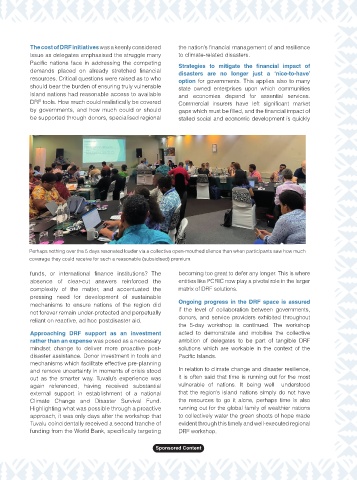
 fully equipped to handle them well. To change this,   Perhaps nothing over the 5 days resonated louder via a collective open-mouthed silence than when participants saw how much
 there must be better data, stronger coordination,   Institutionalisation of strategic DRF planning is a   coverage they could receive for such a reasonable (subsidised) premium.
 an influx of financial resources, and long-term   must if governments are to sustain momentum and
 strategic planning. To reduce the negative financial   secure the progress already made. Establishing long-  funds,  or  international  finance  institutions?  The   becoming too great to defer any longer. This is where
 impact  on  local  economies,  Pacific  nations  ‘must’   term policy frameworks, the creation of dedicated DRF   absence of clear-cut answers reinforced the   entities like PCRIC now play a pivotal role in the larger
 strengthen their disaster response capacity before   working groups, and structured funding allocations   complexity of the matter, and accentuated the   matrix of DRF solutions.
 the next major crisis strikes.  that  prevail beyond  leadership changes were  all   pressing need for development of sustainable   Ongoing  progress  in  the  DRF  space is  assured
 promoted as mechanisms governments can adopt   mechanisms to ensure nations of the region did   if the level of collaboration between governments,
 The lack of accurate and up-to-date exposure and   not forever remain under-protected and perpetually
 vulnerability data is one of the biggest challenges   to securely anchor DRF planning and implementation   reliant on reactive, ad hoc postdisaster aid.  donors, and service providers exhibited throughout
 facing  provision  of  cost-optimised  disaster  risk   capabilities within overarching national disaster risk   the 5-day workshop is continued. The workshop
 financing  across the region.  Without  robust  data,   management strategies.  Approaching DRF support as an investment   acted to demonstrate and mobilise the collective
 the correct pricing of risk becomes difficult, and   rather than an expense was posed as a necessary   ambition of delegates to be part of tangible DRF
 premiums tend to be higher as a result. Regional   A  powerful  realisation  registered  with  workshop   mindset  change  to  deliver  more  proactive  post-  solutions which are workable in the context of the
 cooperation  to  improve  data  collection  and  share   participants when informed that for 2024/25 season,   disaster assistance. Donor investment in tools and   Pacific Islands.
 PCRIC clients had secured a collective total of
 outputs  was  promoted  as a  strategic  means  of   mechanisms which facilitate effective pre-planning
 reducing uncertainty and thereby helping to lower   US$52.75 million in pre-arranged post-disaster   and remove uncertainty in moments of crisis stood   In relation to climate change and disaster resilience,
                                                           it is often said that time is running out for the most
 costs and improve access to more affordable DRF   financial relief. With premium costs substantially offset   out as the smarter way. Tuvalu’s experience was
 solutions.  through PCRIC by financial support from donors,   again  referenced,  having  received  substantial   vulnerable of nations. It being well  understood
 and payouts received within as little as 14 days of a   external support in establishment of a national   that the region’s island nations simply do not have
 Though levels  of  preparedness  vary  between   trigger event occurring, pre-arranged solutions were   Climate Change and Disaster Survival Fund.   the resources to go it alone, perhaps time is also
 nations, progress is evident in regional disaster   shown to be available, accessible, and affordable   Highlighting what was possible through a proactive   running out for the global family of wealthier nations
 risk finance planning. Some nations have made   now. No longer an abstract concept, but a tangible   approach, it was only days after the workshop that   to collectively water the green shoots of hope made
 significant strides, while others still face political,   solution  offering  real,  immediate  financial support   Tuvalu coincidentally received a second tranche of   evident through this timely and well-executed regional
 technical, and financial hurdles. The presentation  when needed most.  funding from the World Bank, specifically targeting   DRF workshop.

 Sponsored Content                                  Sponsored Content


                                                                                             Islands Business, March 2025  25

