


Page 10 - IB March 2025
P. 10
Climate Change                                                                                                                                                                                  Climate Change


                                WALANDE, CLIMATE

          DISPLACEMENT AND HUMAN RIGHTS


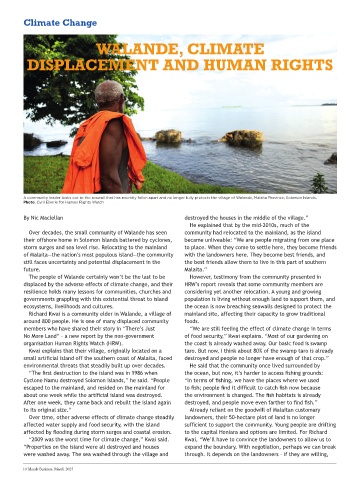
         A community leader looks out to the seawall that has recently fallen apart and no longer fully protects the village of Walande, Malaita Province, Solomon Islands.
         Photo: Cyril Eberle for Human Rights Watch

         By Nic Maclellan                                    destroyed the houses in the middle of the village.”
                                                               He explained that by the mid-2010s, much of the
          Over decades, the small community of Walande has seen   community had relocated to the mainland, as the island
         their offshore home in Solomon Islands battered by cyclones,   became unliveable: “We are people migrating from one place
         storm surges and sea level rise. Relocating to the mainland   to place. When they come to settle here, they become friends
         of Malaita—the nation’s most populous island—the community   with the landowners here. They become best friends, and
         still faces uncertainty and potential displacement in the   the best friends allow them to live in this part of southern
         future.                                             Malaita.”
          The people of Walande certainly won’t be the last to be   However, testimony from the community presented in
         displaced by the adverse effects of climate change, and their   HRW’s report reveals that some community members are
         resilience holds many lessons for communities, churches and   considering yet another relocation. A young and growing
         governments grappling with this existential threat to island   population is living without enough land to support them, and
         ecosystems, livelihoods and cultures.               the ocean is now breaching seawalls designed to protect the
          Richard Kwai is a community elder in Walande, a village of   mainland site, affecting their capacity to grow traditional
         around 800 people. He is one of many displaced community   foods.
         members who have shared their story in “There’s Just   “We are still feeling the effect of climate change in terms
         No More Land” – a new report by the non-government   of food security,” Kwai explains. “Most of our gardening on
         organisation Human Rights Watch (HRW).              the coast is already washed away. Our basic food is swamp
          Kwai explains that their village, originally located on a   taro. But now, I think about 80% of the swamp taro is already
         small artificial island off the southern coast of Malaita, faced   destroyed and people no longer have enough of that crop.”
         environmental threats that steadily built up over decades.  He said that the community once lived surrounded by
          “The first destruction to the island was in 1986 when   the ocean, but now, it’s harder to access fishing grounds:
         Cyclone Namu destroyed Solomon Islands,” he said. “People   “In terms of fishing, we have the places where we used
         escaped to the mainland, and resided on the mainland for   to fish; people find it difficult to catch fish now because
         about one week while the artificial island was destroyed.   the environment is changed. The fish habitats is already
         After one week, they came back and rebuilt the island again   destroyed, and people move even farther to find fish.”
         to its original size.”                                Already reliant on the goodwill of Malaitan customary
          Over time, other adverse effects of climate change steadily   landowners, their 50-hectare plot of land is no longer
         affected water supply and food security, with the island   sufficient to support the community. Young people are drifting
         affected by flooding during storm surges and coastal erosion.  to the capital Honiara and options are limited. For Richard
          “2009 was the worst time for climate change,” Kwai said.   Kwai, “We’ll have to convince the landowners to allow us to
         “Properties on the island were all destroyed and houses   expand the boundary. With negotiation, perhaps we can break
         were washed away. The sea washed through the village and   through. It depends on the landowners – if they are willing,

        10 Islands Business, March 2025

