


Page 8 - IB December 2024
P. 8
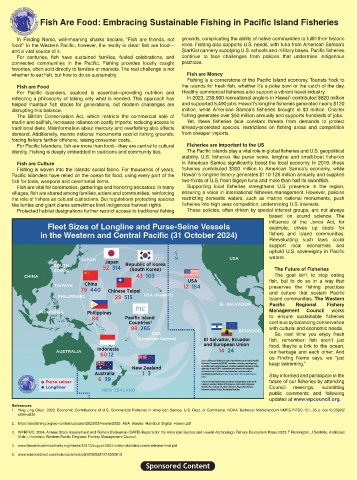
Fish Are Food: Embracing Sustainable Fishing in Pacific Island Fisheries

       In Finding Nemo, well-meaning sharks declare,  “Fish are friends, not   grounds, complicating the ability of native communities to fulfill their historic
     food!” In the Western Pacific, however, the reality is clear: fish are food—  roles. Fishing also supports U.S. needs, with tuna from American Samoa’s
     and a vital source of it.                              StarKist cannery supplying U.S. schools and military bases. Pacific fisheries
       For  centuries,  fish  have  sustained  families,  fueled  celebrations,  and   continue to face challenges from policies that undermine indigenous
     connected communities in the Pacific. Fishing provides locally caught   practices.
     favorites, often sold directly to families or markets. The real challenge is not
     whether to eat fish, but how to do so sustainably.       Fish are Money
                                                              Fishing is a cornerstone of the Pacific Island economy. Tourists flock to
       Fish are Food                                        the islands for fresh fish, whether it’s a poke bowl or the catch of the day.
       For Pacific Islanders, seafood is essential—providing nutrition and   Healthy commercial fisheries also support a vibrant travel industry.
     reflecting a philosophy of taking only what is needed. This approach has   In 2023, 239,900 recreational anglers in Hawai‘i contributed $820 million
     helped maintain fish stocks for generations, but modern challenges are   and supported 5,490 jobs. Hawai‘i’s longline fisheries generated nearly $120
     disrupting this balance.                               million, while American Samoa’s fisheries brought in $3 million. Charter
       The Billfish Conservation Act, which restricts the commercial sale of   fishing generates over $50 million annually and supports hundreds of jobs.
     marlin and sailfish, increases reliance on costly imports, reducing access to   Yet, these fisheries face constant threats from demands to protect
     traditional diets. Misinformation about mercury and overfishing also affects   already-protected species, restrictions on fishing areas and competition
     demand. Additionally, marine national monuments restrict fishing grounds,   from cheaper imports.
     forcing fishers farther offshore, raising consumer costs.
       For Pacific Islanders, fish are more than food—they are central to cultural   Fisheries are Important to the US
     identity. Fishing is deeply embedded in traditions and community ties.   The Pacific Islands play a vital role in global fisheries and U.S. geopolitical
                                                            stability. U.S. fisheries like purse seine, longline and small-boat fisheries
       Fish are Culture                                     in American Samoa significantly boost the local economy. In 2019, these
       Fishing is woven into the islands’ social fabric. For thousands of years,   fisheries contributed $300 million to American Samoa’s economy, while
     Pacific Islanders have relied on the ocean for food, using every part of the   Hawai‘i’s longline fishery generates $110-125 million annually and supplies
     fish for tools, weapons and ceremonial items.          two-thirds of U.S. fresh bigeye tuna and more than half its swordfish.
       Fish are vital for ceremonies, gatherings and honoring ancestors. In many   Supporting local fisheries strengthens U.S. presence in the region,
     villages, fish are shared among families, elders and communities, reinforcing   ensuring a voice in international fisheries management. However, policies
     the role of fishers as cultural custodians. But regulations protecting species   restricting domestic waters, such as marine national monuments, push
     like turtles and giant clams sometimes limit indigenous harvest rights.  fisheries into high seas competition, undermining U.S. interests.
       Protected habitat designations further restrict access to traditional fishing   These policies, often driven by special interest groups, are not always
                                                                                         based on sound science.  The
                                                                                         influence of the Jones Act, for
                                                                                         example, drives up costs for
                                                                                         fishers and island communities.
                                                                                         Reevaluating such laws could
                                                                                         support  local  economies  and
                                                                                         uphold U.S. sovereignty in Pacific
                                                                                         waters.
                                                                                          The Future of Fisheries
                                                                                          The goal isn’t to stop eating
                                                                                         fish, but to do so in a way that
                                                                                         preserves  the fishing  practices
                                                                                         and culture that sustain Pacific
                                                                                         Island communities. The Western
                                                                                         Pacific   Regional   Fishery
                                                                                         Management   Council  works
                                                                                         to ensure sustainable fisheries
                                                                                         continue by balancing conservation
                                                                                         with cultural and economic needs.
                                                                                          So, next time you enjoy fresh
                                                                                         fish, remember: fish aren’t just
                                                                                         food, they’re a link to the ocean,
                                                                                         our  heritage  and  each  other. And
                                                                                         as Finding Nemo says, we  “just
                                                                                         keep swimming.”

                                                                                         Stay informed and participate in the
                                                                                         future of our fisheries by attending
                                                                                         Council  meetings,  submitting
                                                                                         public  comments and  following
                                                                                         updates at www.wpcouncil.org.
     References
     1.  Hing Ling Chan. 2023. Economic Contributions of U.S. Commercial Fisheries in American Samoa. U.S. Dept. of Commerce, NOAA Technical Memorandum NMFS-PIFSC-151, 35 p. doi:10.25923/
       x904-a830
     2.  https://asafishing.org/wp-content/uploads/2023/03/Hawaii/2023_ASA_Senate_Handout_Digital_Hawaii.pdf

     3.  WPRFMC, 2024. Annual Stock Assessment and Fishery Evaluation (SAFE) Reports for the American Samoa and Hawaii Archipelago Fishery Ecosystem Plans 2023. T Remington, J DeMello, A Ishizaki
       (Eds.). Honolulu: Western Pacific Regional Fishery Management Council.

     4.  www.hawaiitourismauthority.org/media/13412/august-2024-visitor-statistics-press-release-final.pdf

     5.  www.sciencedirect.com/science/article/pii/S0308597X18303610
                                                 Sponsored Content
                                                 Sponsored Content
        8 Islands Business, December 2024

