


Page 36 - IB August 2024
P. 36
PNG Ports’


       K10m port


       foreshore


       protection


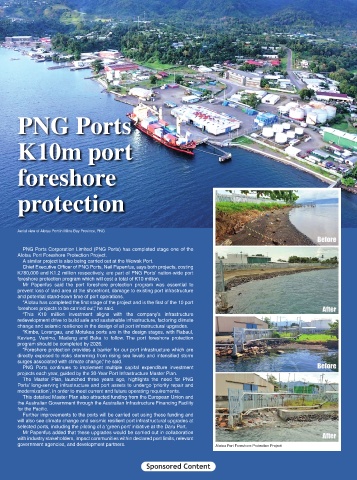
       Aerial view of Alotau Port in Milne Bay Province, PNG


        PNG Ports Corporation Limited (PNG Ports) has completed stage one of the
       Alotau Port Foreshore Protection Project.
        A similar project is also being carried out at the Wewak Port.
        Chief Executive Officer of PNG Ports, Neil Papenfus, says both projects, costing
       K780,000 and K1.2 million respectively, are part of PNG Ports’ nation-wide port
       foreshore protection program which will cost a total of K10 million.
        Mr  Papenfus said  the port  foreshore protection  program was essential  to
       prevent loss of land area at the shorefront, damage to existing port infrastructure
       and potential stand-down time of port operations.
        “Alotau has completed the first stage of the project and is the first of the 10 port
       foreshore projects to be carried out,” he said.
        “This K10 million investment aligns with the company’s infrastructure
       redevelopment drive to build safe and sustainable infrastructure, factoring climate
       change and seismic resilience in the design of all port infrastructural upgrades.
        “Kimbe, Lorengau, and Motukea ports are in the design stages, with Rabaul,
       Kavieng,  Vanimo, Madang and Buka to follow.  The port foreshore protection
       program should be completed by 2026.
        “Foreshore protection provides a barrier for our port infrastructure which are
       directly exposed to risks stemming from rising sea levels and intensified storm
       surges associated with climate change,” he said.
        PNG Ports continues to implement multiple capital expenditure investment
       projects each year, guided by the 30-Year Port Infrastructure Master Plan.
        The Master Plan, launched three years ago, highlights the need for PNG
       Ports’ long-serving infrastructure and port assets to undergo ‘priority repair and
       modernization’, in order to meet current and future operating requirements.
        This detailed Master Plan also attracted funding from the European Union and
       the Australian Government through the Australian Infrastructure Financing Facility
       for the Pacific.
        Further improvements to the ports will be carried out using these funding and
       will also see climate change and seismic resilient port infrastructural upgrades at
       selected ports, including the piloting of a ‘green port’ initiative at the Daru Port.
        Mr Papenfus added that these upgrades would be carried out in collaboration
       with industry stakeholders, impact communities within declared port limits, relevant
       government agencies, and development partners.                  Alotau Port Foreshore Protection Project


                                                 Sponsored Content
        36 Islands Business, August 2024

