


Page 13 - IB May 2024
P. 13
Cover                                                                                               Cover


                                              THE TRAGEDY


                                              OF NEW CALEDONIA


                                           By Nic Maclellan

                                            On the night of Monday 13 May, Noumea exploded.
                                            Across many parts of New Caledonia’s capital, young people took to the streets,
                                           stoning French riot police, looting and burning shops, car yards and factories. The
                                           next day, French High Commissioner Louis Le Franc declared a 6pm to 6am curfew
                                           for Noumea and outlying suburbs, and banned the carrying of weapons – yet the
                                           riots continued over following nights.
                                            Sonia Backès, leader of the anti-independence party Les Loyalistes and President
                                           of the Southern Province wrote to French President Emmanuel Macron, declaring
                                           “we are in a state of civil war.” She called on the French State to declare a state of
                                           emergency and deploy the French army alongside gendarmes and CRS riot police.
                                            Macron soon declared a state of emergency, only the second time in New
                                           Caledonia’s history that French authorities have taken this extraordinary step (the
                                           previous one was announced in December 1984, at the start of four years of armed
                                           conflict known as Les évènements).
                                            Within days, as hundreds more police were flown from Paris and Tahiti to stop
                                           the escalating clashes, France’s Overseas Minister, Gérald Darmanin announced
                                           the house arrest of so-called “radical and violent” Kanak leaders from the activist
                                           network CCAT. The overnight curfew was soon extended beyond Noumea to the
                                           whole territory.
                                            For months, the CCAT has been organising peaceful protests and rallies, backed
                                           by members of the main independence coalition Front de Libération Nationale
                                           Kanak et Socialiste (FLNKS), trade union and Kanak customary leaders. They
                                           called on the French government to withdraw a constitutional amendment that
                                           will change the residency requirements that define New Caledonia citizenship,
                                           first created by the 1998 Noumea Accord. Reducing the residency requirement to
                                           just 10 years, could open the way for more than 25,000 new voters to be added
                                           to electoral rolls for New Caledonia’s three provincial assemblies and national
                                           Congress, an increase of 14.5% new voters in a country of just 270,000 people.
                                            For the last few years, many leaders of the independence movement have
                                           accepted the need for electoral reform, especially to give voting rights to locally
                                           born New Caledonians. However, they have always argued that any compromise on
                                           voting rights—which will clearly benefit anti-independence parties—must be part of
                                           a broader negotiated agreement that includes a clear pathway to a new political
                                           status and political independence.
                                            Talks over the last two years remain deadlocked, despite some private
                                           agreement over issues of common concern. But to the anger of FLNKS leaders,
                                           French President Emmanuel Macron has proceeded with the changes to voting
                                           rights, without forging a final consensus between supporters and opponents of
                                           independence in New Caledonia. The approval of legislation by the French Senate
                                           in Paris on 2 April and the National Assembly on 13 May was the final straw that


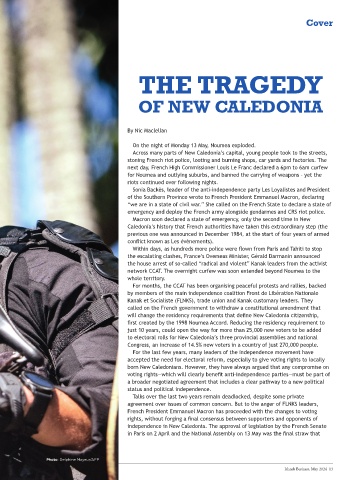
                Photo: Delphine Mayeur/AFP
                                                                                              Islands Business, May 2024  13

