


Page 25 - IB February 2024
P. 25
Education


                                                                                   “How might we
                                                                                   ensure that students
                                                                                   across the region
                                                                                   receive high quality
                                                                                   education despite
                                                                                   the impacts of
                                                                                   climate change
                                                                                   and other related
                                                                                   challenges?”
                                                                                   - EQAP Director, Dr
                                                                                   Michelle Belisle


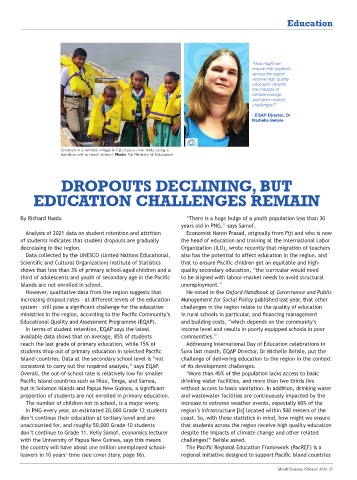
                     Children in a remote village in Fiji cross a river daily using a
                     bamboo raft to reach school. Photo: Fiji Ministry of Education


                     DROPOUTS DECLINING, BUT

            EDUCATION CHALLENGES REMAIN


        By Richard Naidu                                      “There is a huge bulge of a youth population less than 30
                                                            years old in PNG,” says Samof.
         Analysis of 2021 data on student retention and attrition   Economist Naren Prasad, originally from Fiji and who is now
        of students indicates that student dropouts are gradually   the head of education and training at the International Labor
        decreasing in the region.                           Organization (ILO), wrote recently that migration of teachers
         Data collected by the UNESCO (United Nations Educational,   also has the potential to affect education in the region, and
        Scientific and Cultural Organization) Institute of Statistics   that to ensure Pacific children get an equitable and high-
        shows that less than 3% of primary school-aged children and a   quality secondary education, “the curricular would need
        third of adolescents and youth of secondary age in the Pacific   to be aligned with labour-market needs to avoid structural
        Islands are not enrolled in school.                 unemployment.”
         However, qualitative data from the region suggests that   He noted in the Oxford Handbook of Governance and Public
        increasing dropout rates – at different levels of the education   Management for Social Policy published last year, that other
        system – still pose a significant challenge for the education   challenges in the region relate to the quality of education
        ministries in the region, according to the Pacific Community’s   in rural schools in particular, and financing management
        Educational Quality and Assessment Programme (EQAP).  and building costs, “which depends on the community’s
         In terms of student retention, EQAP says the latest   income level and results in poorly equipped schools in poor
        available data shows that on average, 85% of students   communities.”
        reach the last grade of primary education, while 15% of   Addressing International Day of Education celebrations in
        students drop out of primary education in selected Pacific   Suva last month, EQAP Director, Dr Michelle Belisle, put the
        Island countries. Data at the secondary school level is “not   challenge of delivering education to the region in the context
        consistent to carry out the required analysis,” says EQAP.   of its development challenges.
        Overall, the out-of-school rate is relatively low for smaller   “More than 45% of the population lacks access to basic
        Pacific Island countries such as Niue, Tonga, and Samoa,   drinking water facilities, and more than two thirds live
        but in Solomon Islands and Papua New Guinea, a significant   without access to basic sanitation. In addition, drinking water
        proportion of students are not enrolled in primary education.   and wastewater facilities are continuously impacted by the
         The number of children not in school, is a major worry.  increase in extreme weather events, especially 60% of the
         In PNG every year, an estimated 20,000 Grade 12 students   region’s infrastructure [is] located within 500 meters of the
        don’t continue their education at tertiary level and are   coast. So, with those statistics in mind, how might we ensure
        unaccounted for, and roughly 50,000 Grade 10 students   that students across the region receive high quality education
        don’t continue to Grade 11. Kelly Samof, economics lecturer   despite the impacts of climate change and other related
        with the University of Papua New Guinea, says this means   challenges?” Belisle asked.
        the country will have about one million unemployed school-   The Pacific Regional Education Framework (PacREF) is a
        leavers in 10 years’ time (see cover story, page 16).  regional initiative designed to support Pacific Island countries

                                                                                           Islands Business, February 2024  25

